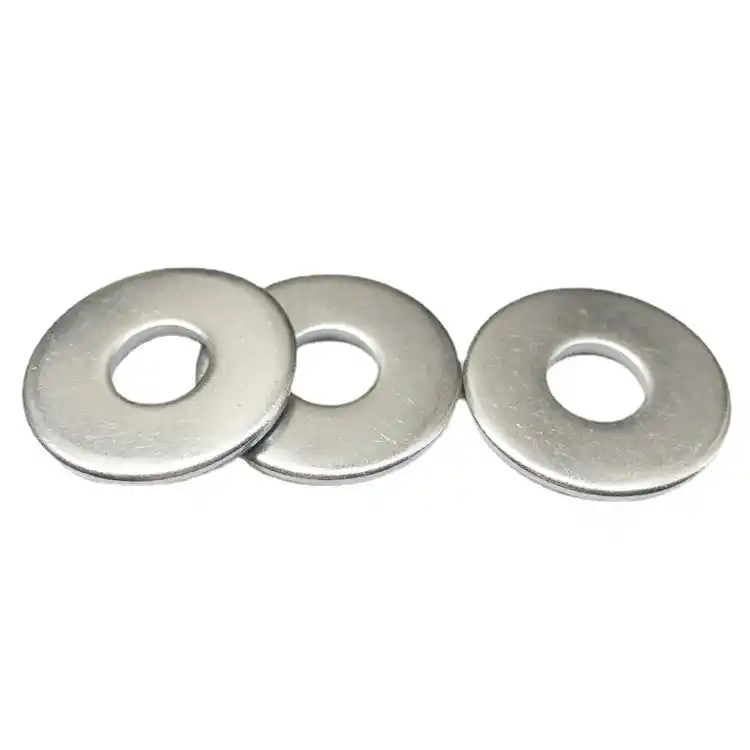
DIN 9021 vs ISO 7093-1: dimensions, hardness and equivalents
DIN 9021 and ISO 7093-1 describe the same basic product concept: metric plain washers with a large outside diameter. Their larger bearing area explains why they are commonly cross-referenced for timber, sheet, insulation, slotted holes and other assemblies where a normal-series washer may provide insufficient coverage.
The formal modern German route is:
DIN 9021 → DIN EN ISO 7093-1
DIN 9021 is withdrawn, but the designation remains common on legacy drawings, supplier catalogues and purchasing searches. The change to ISO is usually practical, although it is not proof that every dimension and mechanical property is identical.
Cross-reference status
| Reference | Why it belongs in the comparison | Required qualification |
|---|---|---|
| DIN EN ISO 7093-1 / ISO 7093-1 | Current German/international route for large-series, product-grade-A plain washers | Check size-specific dimensions and specify 200 HV or 300 HV |
| ISO 7093-2 | Related large-series washer, but product grade C | Do not substitute for Part 1 without checking product grade, tolerances and 100 HV execution |
| UNI 6593 | Historical Italian large-washer purchasing reference | Confirm edition, dimensions, hardness, material and finish; use UNI EN ISO 7093-1 for the modern ISO route |
| JIS B 1256 | Active Japanese plain-washer standard containing a corresponding large-series family | It covers several washer series and is MOD, not blanket identity with DIN 9021 |
| ASME B18.21.1 / legacy B18.22.1 | U.S. inch-series plain-washer purchasing association | Comparable function only; inch sizes are not direct metric replacements |
Why DIN 9021 and ISO 7093-1 can be compared
Both are non-locking metric plain washers from the large series. At many common M sizes they use the same nominal hole, outside diameter and thickness, so ISO 7093-1 is the correct first candidate when a legacy DIN 9021 item must be converted.
The large outside diameter spreads bearing pressure and can cover a larger clearance or slotted hole. That common function creates the valid cross-reference. Interchangeability still depends on the complete washer designation rather than the standard numbers alone.
Representative dimensional comparison
The following nominal dimensions show why the standards are closely related and where a concrete exception occurs. The controlled edition and its tolerances remain the contractual acceptance source.
| Thread size | DIN 9021 OD | ISO 7093-1 OD | DIN thickness | ISO thickness | Result |
|---|---|---|---|---|---|
| M3 | 9 mm | 9 mm | 0.8 mm | 0.8 mm | Same representative values |
| M4 | 12 mm | 12 mm | 1.0 mm | 1.0 mm | Same representative values |
| M5 | 15 mm | 15 mm | 1.2 mm | 1.0 mm | ISO is 0.2 mm thinner |
| M6 | 18 mm | 18 mm | 1.6 mm | 1.6 mm | Same representative values |
| M8 | 24 mm | 24 mm | 2.0 mm | 2.0 mm | Same representative values |
| M10 | 30 mm | 30 mm | 2.5 mm | 2.5 mm | Same representative values |
| M12 | 37 mm | 37 mm | 3.0 mm | 3.0 mm | Same representative values |
| M16 | 50 mm | 50 mm | 3.0 mm | 3.0 mm | Same representative values |
| M20 | 60 mm | 60 mm | 4.0 mm | 4.0 mm | Same representative values |
| M24 | 72 mm | 72 mm | 5.0 mm | 5.0 mm | Same representative values |
| M30 | 92 mm | 92 mm | 6.0 mm | 6.0 mm | Same representative values |
| M36 | 110 mm | 110 mm | 8.0 mm | 8.0 mm | Same representative values |
The table does not support a claim that ISO 7093-1 is generally thicker at larger sizes. Most listed outside diameters and thicknesses coincide. The M5 thickness change is the clear warning that the two standards should not be presented as unconditional dimensional identity.
The M5 difference matters in a controlled stack
A representative M5 comparison is:
- DIN 9021:
5.3 × 15 × 1.2 mm - ISO 7093-1:
5.3 × 15 × 1.0 mm
The 0.2 mm thickness reduction may be harmless in a general assembly, but it changes stack height, available thread engagement and the position of a clamped component. It can also matter where several washers accumulate in a tolerance stack.
Do not invent additional hole-diameter differences by mixing nominal dimensions, minimum limits and tolerance maxima from different tables. For critical clearance, compare d1, d2, thickness and their tolerances from the exact cited editions.
ISO 7093-1 and ISO 7093-2 are different executions
The two parts should not be reduced to “structural” and “commercial” labels:
- ISO 7093-1: large-series plain washers, product grade A, with 200 HV and 300 HV hardness classes.
- ISO 7093-2: large-series plain washers, product grade C, with a 100 HV execution.
Product grade describes the applicable dimensional/tolerance framework; it is not by itself a declaration that an assembly is structural. A structural or safety-critical connection must follow the complete joint specification.
For a legacy DIN 9021 conversion, ISO 7093-1 is the primary modern route. Part 2 is a related large-series product, not an automatic lower-cost substitute.
Hardness is as important as washer diameter
ISO 7093-1 makes the hardness selection explicit:
| ISO execution | Common fastener pairing stated by the standard family | Procurement meaning |
|---|---|---|
| 200 HV | Bolts/screws up to property class 8.8; nuts up to class 8 | State 200 HV rather than ordering only by size and OD |
| 300 HV | Bolts/screws up to property class 10.9; nuts up to class 10 | Use the harder washer where the joint specification requires it |
Legacy DIN 9021 stock may have been supplied under older or lower-hardness requirements. It is unsafe to describe every DIN 9021 washer as one fixed hardness, but it is equally unsafe to assume an unspecified legacy washer satisfies ISO 7093-1 300 HV.
For a 10.9 bolt assembly, do not approve a replacement from geometry alone. Require the washer hardness, material certificate and applicable mechanical-property standard.
JIS B 1256 is valid but broader
JIS B 1256:2008 covers plain washers and was reaffirmed in 2022. It relates to several ISO washer standards, including ISO 7093-1 and ISO 7093-2, as a modified adoption (MOD).
This makes JIS B 1256 a useful Japanese procurement cross-reference, but not a renamed DIN 9021. DIN 9021 corresponds only to the relevant large-series portion. When a JIS item is proposed, identify the washer series and compare hole, outside diameter, thickness, product grade, hardness, material and finish.
UNI 6593 is a historical Italian relation
UNI 6593 can remain in a DIN-first table because it is a familiar historical Italian reference for large plain washers. It helps locate legacy drawings and stock; it does not prove that every DIN, UNI and ISO edition is dimensionally and mechanically identical.
For a new ISO-based Italian specification, use the applicable UNI EN ISO 7093-1 route. For an old UNI 6593 callout, retain the cited edition and check d1, d2, thickness, hardness, material and coating.
ASME is an inch-series functional comparison
ASME plain washers can provide a similar load-distribution function, which is why the U.S. reference is useful for procurement searches. The dimensional system is different:
- DIN 9021 / ISO 7093-1 use metric M-size tables.
- ASME B18.21.1 uses inch-series washer dimensions and series definitions.
- B18.22.1 remains relevant to legacy drawings and searches, but current orders should identify the applicable B18.21.1 edition and washer series.
An inch washer near an M size is not automatically interchangeable. Compare actual hole diameter, OD, thickness and tolerance; then specify material and hardness separately. A nominally nearby 3/8-inch item is not a standards-based replacement for M10 merely because the bolt diameters look similar.
No locking function and no universal temperature rating
DIN 9021 and ISO 7093 are plain washers. They do not provide spring action, serrations, wedge locking or prevailing torque. If vibration resistance is required, define the locking method as a separate part of the joint design.
Neither standard number establishes one universal service-temperature range. Temperature capability depends on material, hardness, coating, lubricant, mating fasteners, load and environment. Do not assign generic zinc-plated carbon-steel or stainless-steel temperature limits from the washer designation alone.
Replacement decision table
| Proposed replacement | Decision | Required check |
|---|---|---|
| DIN 9021 → DIN EN ISO 7093-1 | Correct formal German route | M5 thickness; all controlled dimensions/tolerances; 200 or 300 HV |
| DIN 9021 → ISO 7093-1 | Same large-series family; usually practical after verification | Edition, d1, d2, thickness, hardness, material and finish |
| DIN 9021 → ISO 7093-2 | Related product, not an automatic equivalent | Product grade C, tolerances, 100 HV and joint requirements |
| DIN 9021 → UNI 6593 | Historical Italian purchasing relation | Edition, dimensions and mechanical execution |
| DIN 9021 → JIS B 1256 | Qualified Japanese family relation | Select the large-series portion and account for MOD provisions |
| DIN 9021 → ASME inch washer | Functional comparison only | Inch series, actual dimensions, hardness and engineering approval |
RFQ checklist
- State the controlled standard and edition; for new German work, normally specify DIN EN ISO 7093-1.
- Specify nominal M size and required hole tolerance.
- Confirm outside diameter, thickness and assembly stack height, especially M5.
- State 200 HV or 300 HV and match it to the bolt/nut property class.
- Specify steel or stainless grade and the applicable material/mechanical standard.
- Specify coating or passivation and corrosion requirement separately.
- For JIS, name the large-series execution; for ASME, state the exact inch washer series and size.
- State any locking method, service temperature and certification requirement separately.
Browse flat washers or send the legacy drawing through the contact page for a controlled standard comparison.
Procurement conclusion
DIN EN ISO 7093-1 is the modern German replacement route for DIN 9021. The same large-series function and mostly matching common dimensions explain why the standards can be cross-referenced; the M5 thickness change and explicit ISO hardness classes explain why the relationship is not unconditional identity. Keep UNI 6593 and the large-series portion of JIS B 1256 as qualified regional associations. Keep ASME as an inch-series functional comparison, not a direct metric equivalent.