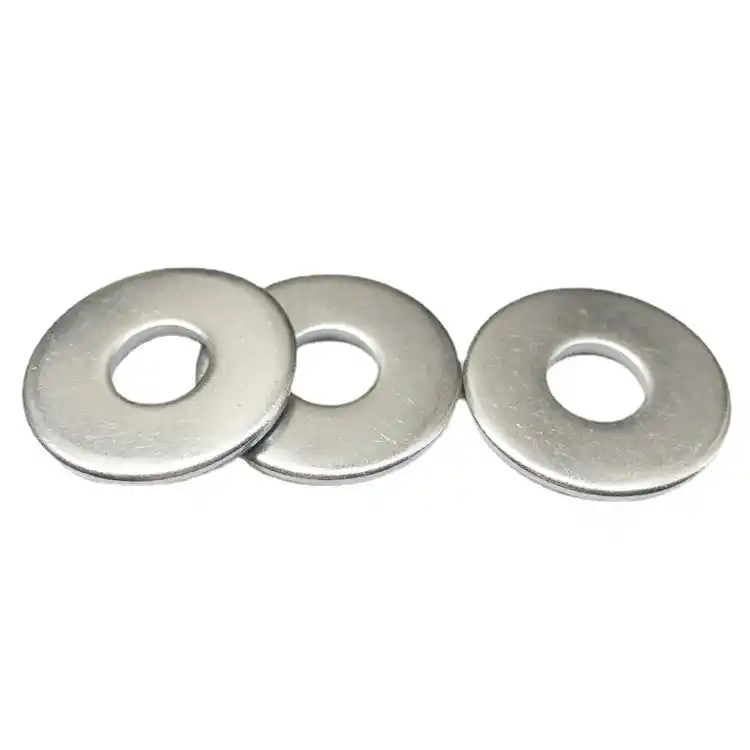
Quick answer: can ISO 7090 replace DIN 125B?
For most ordinary sourcing applications, ISO 7090 is the correct current replacement reference for a DIN 125B chamfered plain washer, provided that the nominal size, bore, outside diameter, thickness, chamfer, hardness, material and finish meet the drawing and joint requirements. DIN EN ISO 7090 is the German adoption of ISO 7090.
This is a strong legacy-to-current cross-reference, but it is not permission to change every controlled drawing automatically. Confirm the cited edition and obtain approval for safety-critical, regulated or tightly tolerance-controlled assemblies.
DIN 125B cross-reference at a glance
| Standard | Washer form | Status or relationship | Replacement decision |
|---|---|---|---|
| DIN 125B | Plain washer, normal series, with outside-edge chamfer | Widely used legacy DIN designation | Retain when the drawing or contract requires it |
| ISO 7090 | Plain washer, chamfered, normal series, product grade A | Current international reference | Principal replacement candidate for DIN 125B |
| DIN EN ISO 7090 | German adoption of ISO 7090 | Current German ISO-based reference | Normally the preferred designation for a new German specification |
| DIN 125A | Plain washer without chamfer | Different legacy form | Compare with ISO 7089, not ISO 7090 |
| ISO 7089 | Plain washer without chamfer, normal series, product grade A | Different edge form | Not the same form as ISO 7090 |
The essential mapping is:
- DIN 125A → ISO 7089: without chamfer
- DIN 125B → ISO 7090: with outside-edge chamfer
Do not collapse both forms into one generic “DIN 125 washer” when the drawing controls the edge form.
What DIN 125B and ISO 7090 cover
DIN 125B is the familiar legacy designation for a normal-series metric plain washer with a chamfered outside edge. ISO 7090 defines the corresponding international product as a chamfered normal-series plain washer of product grade A.
The old DIN designation remains common in catalogues, drawings and purchase orders. Commercial use of the name does not make it a separate current alternative to DIN EN ISO 7090. For a new German specification, DIN EN ISO 7090 is normally the clearer current reference; for a legacy drawing, retain the original callout until the conversion is approved.
View the related DIN 125B washer drawing and dimensions, or browse flat washers.
DIN 125B vs ISO 7090: are the dimensions identical?
The legacy DIN 125B and ISO 7090 dimensional systems are intended to correspond for the chamfered normal-series washer. That makes ISO 7090 the logical replacement starting point, but the standard number alone is not a complete dimensional approval.
For the exact nominal size and cited editions, compare:
| Dimension or feature | Why it matters |
|---|---|
| Bore diameter and tolerance | Controls clearance over the bolt or screw and support around the hole |
| Outside diameter and tolerance | Controls bearing area and fit inside a pocket or counterbore |
| Thickness and tolerance | Affects stack height, stiffness and resistance to dishing or embedment |
| Outside-edge chamfer | Distinguishes the B / ISO 7090 form from the unchamfered A / ISO 7089 form |
| Flatness and product grade | Affect seating and the uniformity of the bearing interface |
| Nominal size range | A legacy DIN size may not have the same preferred status in a current ISO table |
Use the controlled standard or drawing for acceptance limits. A distributor's single nominal-value table is useful for selection, but it does not replace the minimum and maximum dimensions in the applicable edition.
What the chamfer means—and what it does not mean
ISO 7090 and DIN 125B are identified by a chamfer on the washer's outside edge. The chamfer is a geometric form requirement; it is not a spring feature, serration or locking mechanism.
Do not explain this outside-edge chamfer as clearance for the radius under a bolt head. A feature intended to clear an under-head or under-nut fillet would need to be located at the bore-side bearing edge. The ISO 7090 designation instead distinguishes the specified external edge form from the unchamfered ISO 7089 washer.
A chamfered DIN 125B / ISO 7090 washer therefore must not be marketed as a lock washer. If the joint requires resistance to self-loosening, specify and validate the locking method for the complete joint.
Hardness matters as much as dimensions
Washers do not use bolt property classes such as 8.8 or 10.9. ISO normal-series washers are selected using washer hardness requirements, commonly including 200 HV and 300 HV, together with the applicable material and mechanical-property rules.
As a general selection principle:
- 200 HV washers are used with fasteners only within the application limits assigned to that hardness class, commonly including bolts and screws up to property class 8.8.
- 300 HV washers cover higher bearing demands within their stated scope, commonly including bolts and screws up to property class 10.9.
- A property class 12.9 assembly must not be assumed to be covered merely by selecting a 300 HV ISO 7090 washer; check the governing joint or assembly standard.
Do not call a washer “8.8” or “10.9,” and do not treat 300 HV as an unconditional premium default. The correct hardness depends on the bolt, bearing stress, connected material, coating and applicable assembly requirements. A washer that is too soft can dish or embed; a hard washer against a delicate bearing surface can create a different interface problem.
Material and finish are separate requirements
The dimensional designation does not fully specify material or corrosion performance. Commercial ISO 7090 / DIN 125B washers may be supplied in carbon or alloy steel, stainless steel and application-specific materials, with finishes such as plain, zinc plated, zinc flake or passivated stainless.
A stainless washer and a 300 HV carbon-steel washer can share the same nominal geometry without being performance substitutes. State material, hardness or applicable mechanical requirement, coating, corrosion class and inspection documentation separately.
There is also no universal DIN 125B or ISO 7090 operating-temperature rating. Temperature suitability comes from the actual material, coating, joint preload requirement and environment.
DIN 125B vs other ISO washer series
The same nominal bolt size can accept washers from several dimensional series, but that does not make those washers interchangeable.
| Standard | General washer type | Main distinction from ISO 7090 |
|---|---|---|
| ISO 7089 | Normal series, product grade A, without chamfer | Different edge form |
| ISO 7090 | Normal series, product grade A, chamfered | Reference covered on this page |
| ISO 7091 | Normal series, product grade C | Different product grade and tolerances |
| ISO 7092 | Small series, product grade A | Smaller outside diameter and bearing area |
| ISO 7093-1 / 7093-2 | Large series | Larger outside diameter; product grade depends on the part |
| ISO 7094 | Extra-large series, product grade C | Much larger bearing envelope |
Structural or highly preloaded joints may require a dedicated structural washer and assembly standard rather than a general ISO 7090 washer. Choose by the governing joint specification, not by whichever washer happens to fit the bolt.
Interchangeability decision
| Proposed change | General assessment | Required check |
|---|---|---|
| ISO 7090 ↔ DIN EN ISO 7090 | Normally the same adopted ISO requirement | Match the cited editions, hardness, material and finish |
| DIN 125B → ISO 7090 | Common legacy-to-current conversion | Check dimensions, chamfer, hardness and drawing approval |
| DIN 125A / ISO 7089 → ISO 7090 | Different edge form | Do not change without a form and bearing-interface review |
| Another ISO washer series → ISO 7090 | Different OD, thickness, grade or tolerances may apply | Compare the complete dimensional tables and joint envelope |
| Inch-series washer → ISO 7090 | Different dimensional system | Compare bore, OD, thickness, material and hardness; obtain approval |
Physical fit over the bolt proves only that the bore is large enough. It does not confirm outside diameter, thickness, bearing area, hardness or compliance with the drawing.
RFQ and purchase-order checklist
Include:
- Standard and edition, if drawing-controlled
- DIN 125B form B or ISO 7090 designation
- Nominal fastener size
- Drawing-controlled bore, outside diameter and thickness
- Required hardness class or governing mechanical specification
- Material and surface treatment
- Corrosion and service-environment requirements
- Quantity, inspection certificate and traceability
- Approval reference for a DIN-to-ISO conversion
Example:
Chamfered normal-series plain washer, ISO 7090, M16, 300 HV, zinc-flake coated; proposed as the approved replacement for drawing callout DIN 125B.
Frequently asked questions
Is DIN 125B the same as ISO 7090?
ISO 7090 is the correct current international cross-reference for the DIN 125B chamfered normal-series washer. Confirm the exact edition, dimensions, tolerances, hardness, material and finish before a controlled substitution.
What is the difference between DIN 125A and DIN 125B?
DIN 125A is the legacy form without chamfer and is commonly compared with ISO 7089. DIN 125B has a chamfered outside edge and corresponds to ISO 7090. They should remain separate identities.
Does the chamfer make DIN 125B a lock washer?
No. It is still a plain washer. The outside-edge chamfer does not provide spring action or a validated anti-loosening mechanism.
Should I choose 200 HV or 300 HV?
Choose hardness from the mating fastener property class, bearing stress, connected material and governing joint standard. Do not select solely from nominal size, and do not assume 300 HV is correct for every application.
Can any M16 flat washer replace DIN 125B M16?
No. Another M16 washer can have a different bore, outside diameter, thickness, edge form, product grade or hardness. Compare the full standard and joint requirements.
Final recommendation
Use ISO 7090 or DIN EN ISO 7090 for a new chamfered normal-series metric washer specification. When converting an existing DIN 125B callout, verify the cited edition, bore, outside diameter, thickness, chamfer, hardness, material and finish, then document approval. Keep DIN 125A / ISO 7089 and other washer series separate: nominal bolt size alone never proves washer equivalence.