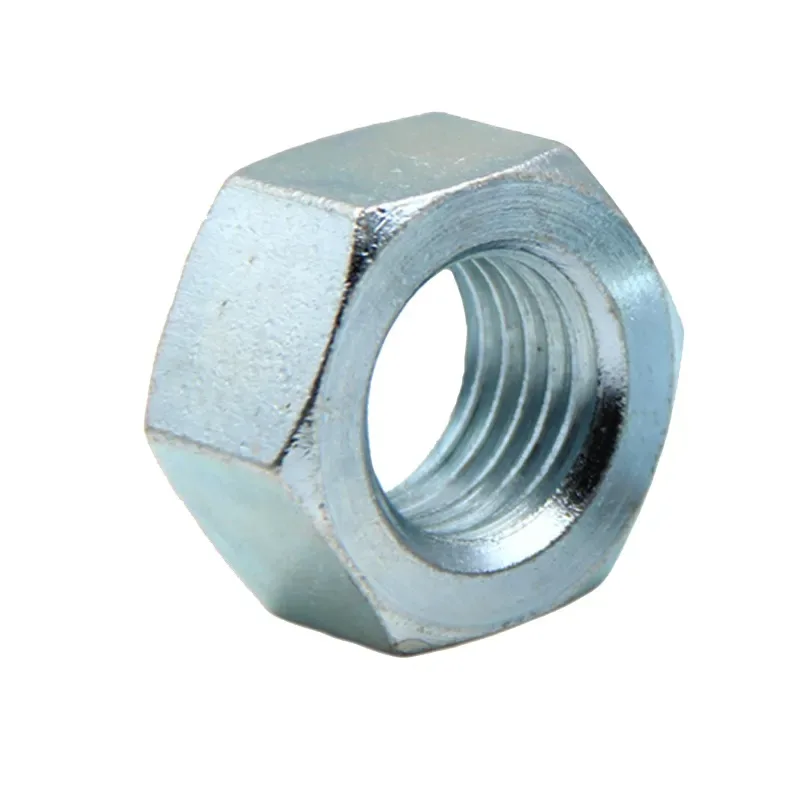
Quick answer: what replaced DIN 6915?
DIN 6915 is withdrawn, but the designation remains common on structural drawings, legacy bills of material, supplier catalogues and RFQs. Its verified current German/European successor route is DIN EN 14399-4 for preloaded System HV hexagon bolt and nut assemblies.
ISO 4775:1984 is the close historical ISO counterpart, not a current replacement: ISO 4775 is also withdrawn. For legacy sourcing, keep both numbers searchable. For a new or changed structural joint, approve the complete DIN EN 14399-4 assembly rather than replacing only the nut number.
| Reference | Status and purchasing relationship |
|---|---|
| DIN 6915 | Withdrawn German legacy structural nut; still widely specified in industry |
| ISO 4775:1984 | Withdrawn close historical counterpart, M12–M36, product grade B, classes 8 and 10 |
| DIN EN 14399-4 | Current German/European System HV bolt-and-nut assembly route |
| ASME B18.2.6 | Related US structural fastener dimensional system; not a direct metric equivalent |
| ASME B18.2.6M | Historical metric comparison; check edition and dimensions before use |
| UNI 5713 | Historical Italian counterpart for the same broad structural-nut family |
| JIS B 1186 | Related Japanese friction-grip bolt, nut and washer system |
Compare the companion DIN 6914 structural bolt, review the current DIN EN 14399-4 route, or browse EN 14399 heavy hex nuts.
Why DIN 6915 and ISO 4775 can be cross-referenced
The two standards describe the same historical product concept:
- a high-strength structural hexagon nut;
- large width across flats;
- ISO metric coarse internal thread;
- compatibility with high-strength structural bolts;
- controlled proof-load performance;
- use with structural washers in preloaded steel connections.
The later DIN and ISO editions are documented as closely corresponding, so the relationship is stronger than a generic “similar product” link. It must still be edition-qualified: identical nominal thread does not by itself settle coating allowance, tolerance, proof load or approval of the complete assembly.
DIN 6914, DIN 6915 and DIN 6916 belong together
The legacy DIN purchasing chain is:
| Component | Legacy DIN reference | Function |
|---|---|---|
| Bolt | DIN 6914 | High-strength structural bolt with large head and short thread |
| Nut | DIN 6915 | High-strength structural nut with large width across flats |
| Washer | DIN 6916 | Hardened structural washer; DIN 6917/6918 cover related bevelled forms |
DIN 6915 is therefore not simply a larger DIN 934 / ISO 4032 nut. A same-thread general-purpose nut may have another width, height, proof load, bearing geometry and no qualification for the required preloaded assembly.
Concrete DIN 6915 / ISO 4775 dimensions
Representative ISO 4775 values that closely follow the legacy DIN 6915 family are:
| Thread | Coarse pitch P | Width across flats s | Minimum across corners e | Nominal height m |
|---|---|---|---|---|
| M12 | 1.75 mm | 22 mm | 23.91 mm | 10 mm |
| M16 | 2.00 mm | 27 mm | 29.56 mm | 13 mm |
| M20 | 2.50 mm | 32 mm | 35.03 mm | 16 mm |
| M22 | 2.50 mm | 36 mm | 39.55 mm | 18 mm |
| M24 | 3.00 mm | 41 mm | 45.20 mm | 19 mm |
| M27 | 3.00 mm | 46 mm | 50.85 mm | 22 mm |
| M30 | 3.50 mm | 50 mm | 55.37 mm | 24 mm |
| M36 | 4.00 mm | 60 mm | 66.44 mm | 29 mm |
These dimensions explain why an ordinary nut is not a substitute. For example, DIN 6915 / ISO 4775 M24 uses a 41 mm wrench size and nominal height of 19 mm. A replacement check must also include bearing face, chamfer, internal thread tolerance and proof-load requirements.
Nut class 8 or 10 is not bolt class 8.8 or 10.9
This first-article explanation is worth retaining because it answers a frequent purchasing question:
- bolt classes such as
8.8and10.9encode tensile-strength and yield/proof relationships; - nut classes such as
8and10express proof-load capability for use with compatible bolt classes; ISO 4775 M24 – 10therefore means a class 10 nut, not a “10.9 nut”.
ISO 4775 provides nut classes 8 and 10 for structural bolts in the 8.8/10.9 family. A higher nominal nut class must not be treated as automatic permission to mix components in a qualified preloaded assembly. DIN EN 14399-4 suitability, manufacturer pairing, coating, lot and project specification still govern.
Hot-dip galvanizing changes the thread check
Structural nuts are often hot-dip galvanized. The coating system affects internal-thread allowance, tapping condition, fit with the coated bolt and tightening behaviour. An RFQ must state whether the nut and bolt are plain or coated and how the mating thread system is controlled.
Do not approve a replacement from M24 alone. Confirm:
- coarse pitch;
- internal-thread tolerance and allowance;
- whether dimensions apply before or after coating;
- mating bolt coating and thread condition;
- assembly tightening characteristic after coating/lubrication.
ASME and ASTM split dimensions from material performance
The first article is also useful here, but the current and historical documents must be separated carefully:
- ASME B18.2.6 is the related US structural-fastener dimensional route, primarily using inch dimensions and Unified threads.
- ASTM A563 / A563M supplies nut material and mechanical-grade requirements in the US system.
- ASTM F3125/F3125M supplies the corresponding structural bolt grades.
- ASME B18.2.6M is a historical metric comparison and should not be presented as automatically current or identical to DIN/ISO.
Even the metric geometries are not universally the same:
| Metric example | DIN 6915 / ISO 4775 | Historical ASME B18.2.6M | Result |
|---|---|---|---|
| M20 width across flats | 32 mm | 34 mm | Socket and envelope differ |
| M24 width across flats | 41 mm | 41 mm | This dimension matches, but the whole standard still must be checked |
For an inch ASME order, the thread system itself prevents direct substitution. For a metric comparison, the M20 example proves that “metric heavy structural nut” does not guarantee identical geometry.
Why JIS B 1186 appears on both bolt and nut pages
This is not duplicated data. JIS B 1186 covers a Japanese high-strength friction-grip bolting set, so the same base standard is relevant to the bolt, nut and washer. The line item and the applicable component table must be identified on an RFQ.
JIS remains a functional sourcing counterpart, not a drop-in DIN replacement:
| M24 comparison | DIN 6915 / ISO 4775 | JIS B 1186 |
|---|---|---|
| Width across flats | 41 mm | 41 mm |
| Nut height | 19 mm | 24 mm |
The same wrench size hides a 5 mm height difference. JIS strength designations, component markings, washer requirements and friction-grip assembly rules also belong to the JIS system.
UNI 5713 is a historical regional counterpart
UNI 5713 can remain in the cross-reference as the historical Italian counterpart to this large-width structural nut family. It is not the current European replacement. Confirm the UNI edition, dimensional table, nut class, coating and matching components; use DIN EN 14399-4 for the current European System HV route.
DIN 6915 is not a locknut
DIN 6915 has no nylon insert, deformed prevailing-torque zone, serrations or captive locking ring. Joint security comes from the specified structural assembly, controlled preload, friction and installation procedure. It should not be categorized as a self-locking nut.
There is likewise no universal temperature rating. Capability depends on steel, heat treatment, coating, preload retention, environment and the applicable structural design rules.
DIN EN 14399-4 is an assembly replacement
DIN 6915 historically names the nut. DIN EN 14399-4 controls System HV preloaded bolt and nut assemblies within the EN 14399 family. Conversion therefore requires more than matching M24, s = 41 mm and class 10.
Check the complete set:
- compatible bolt and nut from a declared assembly;
- structural washer type, dimensions, hardness and orientation;
- thread, nut height, bearing geometry and coating allowance;
- bolt grip and protrusion after tightening;
- property class and component markings;
- declared tightening characteristic or coefficient class where specified;
- required preload, installation and inspection method;
- manufacturer, assembly lot and inspection documentation.
RFQ and replacement checklist
For a legacy callout such as DIN 6915 M24 – 10, hot-dip galvanized, confirm:
- Original DIN edition and whether the project accepts DIN EN 14399-4.
- Diameter, coarse pitch, internal-thread tolerance and coating allowance.
- Width across flats
s, across cornerse, heightmand bearing face. - Nut proof-load class and compatible bolt class/system.
- Matching DIN/EN bolt and structural washer requirements.
- Plain, galvanized or other coating condition and lubrication.
- Preload, tightening characteristic, installation and inspection method.
- Whether ASME/ASTM, UNI or JIS is only a sourcing comparison or an approved project alternative.
- Component markings, manufacturer pairing, lot traceability and certificates.
Purchasing conclusion
DIN 6915 remains an important industry keyword and legacy procurement designation, but it is no longer the official current German standard. ISO 4775 is its withdrawn close historical counterpart. ASME, UNI and JIS remain useful approximate regional links because they serve the same structural function, but the M20 ASME width and M24 JIS height examples show why they are not blanket equivalents. For current European work, approve the complete DIN EN 14399-4 System HV assembly.