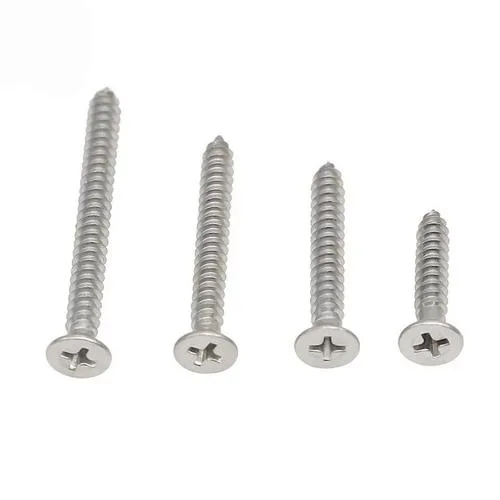
DIN 7982 vs ISO 7050: exact differences and replacement guide
DIN 7982 and ISO 7050 describe the same basic product family: cross-recessed countersunk (flat) head tapping screws with ST threads. That is why they belong in one purchasing cross-reference. They are not proof that every legacy DIN screw is dimensionally identical to every ISO screw.
The formal modern German route is:
DIN 7982 → DIN EN ISO 7050
DIN 7982 is withdrawn, although its number remains common on drawings, catalogues and RFQs. ISO 7050:2011 is the active international product standard for ST 2.2 through ST 9.5.
Cross-reference status at a glance
| Reference | Why it can be compared | What prevents automatic substitution |
|---|---|---|
| DIN EN ISO 7050 / ISO 7050 | Current German/international route for the same head, drive and ST tapping-screw family | Head dimensions, size range, point, recess and controlled edition still matter |
| UNI 6955 | Historical Italian cross-recessed countersunk tapping-screw reference, especially Form C | Confirm edition, point form and dimensional table |
| JIS B 1122 | Japanese cross-recessed tapping-screw family; modified adoption related to ISO 7049, 7050 and 7051 | DIN 7982 corresponds only to the ISO 7050-related countersunk portion; JIS is MOD, not IDT |
| ASME B18.6.3 | Contains comparable US inch-series cross-recessed flat-head tapping screws | Inch threads, head geometry and the applicable ASME configuration differ |
| JIS B 1115 | None for the DIN 7982 drive form | It specifies slotted-head tapping screws and is the wrong direct mapping |
Why DIN 7982 and ISO 7050 can be cross-referenced
Both define a 90-degree countersunk head, a cross recess and an ST tapping-screw thread. Both are intended to form or engage a mating thread in a prepared hole and to seat substantially flush in a matching countersink. This common function makes ISO 7050 the correct starting point for replacing a DIN 7982 callout.
The replacement must still be checked because the dimensional tables were not reproduced unchanged.
Concrete head-diameter differences
The following representative values compare frequently cited DIN 7982:1990 and ISO 7050:2011 head-diameter limits. Use the controlled edition named by the drawing for final acceptance.
| ST size | DIN 7982 head diameter dk max/min |
ISO 7050 dk max/min |
Practical difference |
|---|---|---|---|
| ST 2.2 | 4.30 / 4.00 mm | 3.80 / 3.50 mm | ISO head is 0.50 mm smaller at both limits |
| ST 2.9 | 5.50 / 5.20 mm | 5.50 / 5.20 mm | Representative limits coincide |
| ST 3.5 | 6.80 / 6.44 mm | 7.30 / 6.90 mm | ISO head is about 0.46–0.50 mm larger |
| ST 4.2 | 8.10 / 7.74 mm | 8.40 / 8.00 mm | ISO head is about 0.26–0.30 mm larger |
| ST 4.8 | 9.50 / 9.14 mm | 9.30 / 8.90 mm | ISO head is about 0.20–0.24 mm smaller |
| ST 5.5 | 10.80 / 10.37 mm | 11.30 / 10.90 mm | ISO head is about 0.50–0.53 mm larger |
| ST 6.3 | 12.40 / 11.97 mm | 12.60 / 12.00 mm | ISO maximum is 0.20 mm larger; minima are close |
These differences affect countersink coverage, the visible ring around the head, edge clearance and whether the head finishes flush. Head height and recess depth must also be taken from the selected edition rather than inferred from nominal ST size.
The ISO size range is broader
The historical DIN 7982 table is commonly encountered from ST 2.2 to ST 6.3, including ST 3.9 as a non-preferred legacy size. ISO 7050 covers ST 2.2 to ST 9.5 and includes ST 8 and ST 9.5.
Therefore, an ISO 7050 ST 8 or ST 9.5 screw belongs to the modern ISO family but should not be described as an original DIN 7982 size.
ST thread is not an M machine thread
ST 4.2 is not M4, and ST 4.8 is not M4.8. ST identifies a tapping-screw thread; M identifies an ISO metric machine thread for a tapped hole or nut. Even where major diameters appear close, pitch, profile, pilot hole and installation behaviour differ.
For corresponding ISO tapping-screw sizes, typical pitches include 1.4 mm for ST 4.2, 1.6 mm for ST 4.8 and 1.8 mm for ST 5.5 and ST 6.3. Never convert an ST callout to M or a US number size from diameter alone.
Countersink angle: 90 degrees is not 82 degrees
DIN 7982 / ISO 7050 use the metric 90-degree countersunk geometry. The relevant ASME B18.6.3 flat-head tapping-screw configurations commonly use an 82-degree head.
An 82-degree screw in a 90-degree seat, or the reverse, changes the contact band, seating depth and head projection. It can create edge contact and a visibly proud or recessed head. The hole angle must therefore be checked whenever an ASME alternative is proposed.
Recess, point and length must stay in the callout
ISO 7050 cross recesses include H and Z configurations. They are related in the market to Phillips-type and Pozidriv-type drives, but “cross head” alone does not define the recess. Retain the recess type and number, especially for controlled-torque or automatic assembly.
Legacy DIN and current ISO information may identify point or thread-end forms such as C, F and R. The point changes starting behaviour, pilot-hole engagement and required blind clearance. Select by the controlled table, not only by ST diameter × length.
Because this is a countersunk screw, the head is included in the nominal overall length. A pan-head screw of the same stated length does not have the same under-head reach.
Why JIS B 1115 is wrong and JIS B 1122 is qualified
JIS B 1115:2015 is titled Slotted head tapping screws. Its related international family is ISO 1481, ISO 1482 and ISO 1483. A slotted drive is already a fundamental functional difference from DIN 7982.
JIS B 1122:2015 is the relevant Japanese cross-recessed head tapping screw family for ST 2.2–ST 9.5. It is a modified adoption related to ISO 7049, ISO 7050 and ISO 7051. DIN 7982 maps only to its ISO 7050-related countersunk-head portion. Because the adoption is MOD, confirm the JIS head form, recess, dimensions and edition instead of labelling the complete JIS standard identical to DIN 7982.
There is also no sound basis for saying every JIS B 1122 screw universally requires a special “JIS bit”; procure by the actual recess designation and size.
UNI 6955 and ASME B18.6.3
UNI 6955 is a useful and comparatively strong historical Italian purchasing relationship for cross-recessed countersunk tapping screws, particularly Form C. Keep it in the cross-reference, but retain the form and compare the cited UNI edition with the DIN/ISO head, point and length table.
ASME B18.6.3 is a broader US inch-series standard containing several machine-screw and tapping-screw configurations. It can support a functional redesign, but the RFQ must identify the exact cross-recessed flat-head tapping-screw type. Compare number size or inch diameter, TPI, point, 82-degree head, head diameter/height, recess, pilot hole and installation performance. ST 4.2 ≈ #8 is not an approval rule.
Material, coating, locking and temperature
DIN 7982 / ISO 7050 is a dimensional product designation, not a structural-bolt property class. Do not add 8.8, 10.9 or 12.9 by analogy. Steel tapping-screw properties may be specified through ISO 2702; stainless requirements may use ISO 3506-4 or a controlled purchase specification. Material, hardness or property designation must be stated separately.
Coating also requires a separate callout, for example electroplating, zinc flake or stainless passivation under the applicable specification. For hardened carbon-steel screws, coating and hydrogen-embrittlement controls are procurement-critical.
The countersunk head has no integral washer and no inherent locking patch, serration or prevailing-torque feature. A finishing washer or locking treatment is a separate component or modification. Neither standard gives one universal service-temperature limit; temperature depends on material, heat treatment, coating, lubricant, substrate, load and environment.
Replacement decision table
| Proposed replacement | Decision | Required check |
|---|---|---|
| DIN 7982 → DIN EN ISO 7050 | Correct formal route | ST size, dk, head height, recess, point, length, material and finish |
| DIN 7982 → ISO 7050 | Same product family, normally suitable after verification | Existing countersink and controlled dimensional edition |
| DIN 7982 → UNI 6955 | Strong historical regional relation | UNI edition and form, especially Form C |
| DIN 7982 → JIS B 1122 | Qualified Japanese relation | Select only the ISO 7050-related countersunk portion and compare MOD differences |
| DIN 7982 → JIS B 1115 | Incorrect direct mapping | Slotted drive does not match |
| DIN 7982 → ASME B18.6.3 | Functional alternative only | Inch thread, exact ASME type and 82-degree seat require redesign approval |
RFQ checklist
Before approving a replacement, state:
- Controlled standard and edition: legacy DIN 7982 or current DIN EN ISO 7050.
- Full ST designation and length; do not translate it to M or a US number by diameter alone.
- Head diameter/height limits and the component's 90-degree countersink.
- H or Z recess and recess number.
- C, F, R or other specified point form and the pilot-hole requirement.
- Material and mechanical-property specification.
- Coating, passivation, corrosion target and hydrogen-embrittlement controls where applicable.
- Flushness, installation torque and pull-out/strip performance in the real substrate.
For current sourcing, see cross-recessed countersunk self-tapping screws or send the legacy drawing through the contact page.
Procurement conclusion
Use DIN EN ISO 7050 as the current German replacement path for DIN 7982. The shared 90-degree countersunk head, cross recess and ST thread explain why the standards can be compared; the documented head-diameter changes, broader ISO size range and point/recess choices explain why they are not blindly identical. Retain UNI 6955 and JIS B 1122 as qualified regional purchasing relations, reject JIS B 1115 as a direct equivalent, and treat ASME B18.6.3 as an inch-system functional alternative requiring engineering review.