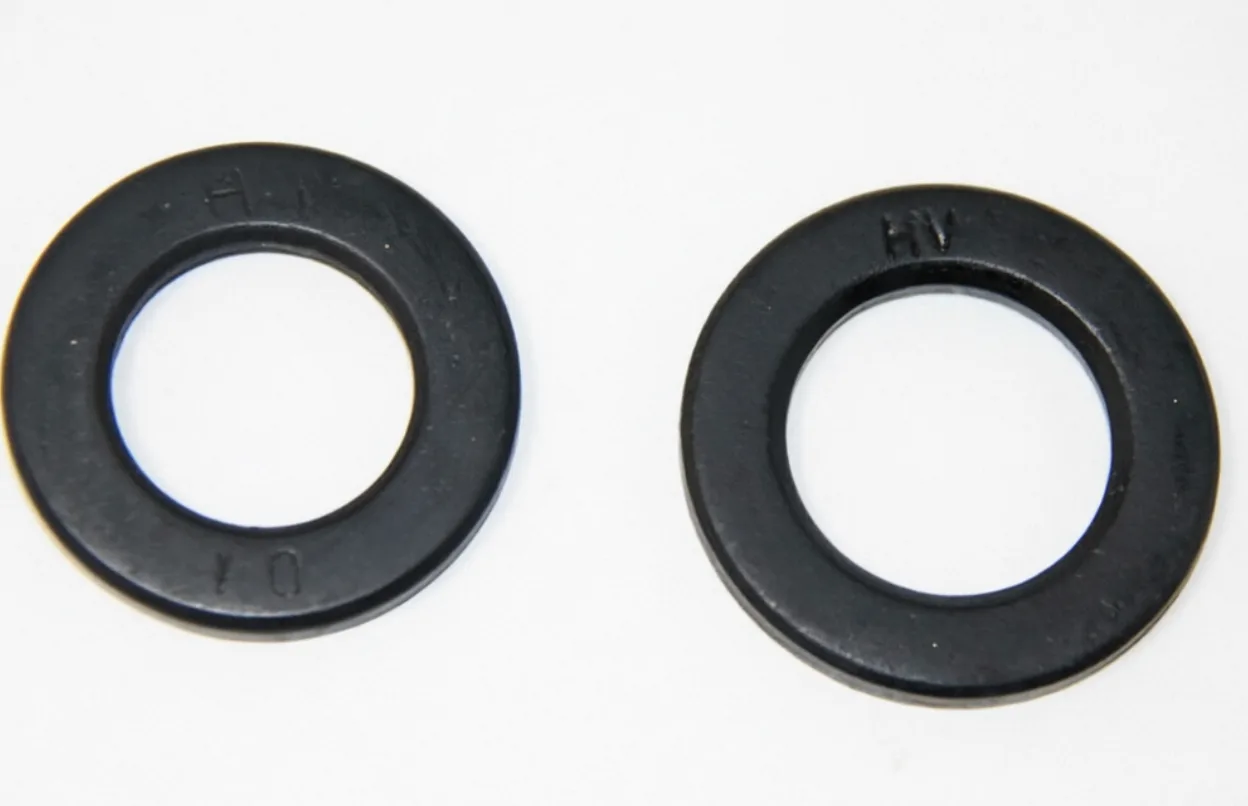
Quick answer: what replaced DIN 6916?
DIN 6916:1989 is withdrawn, but the designation remains common on structural drawings, legacy bills of material, supplier catalogues and RFQs. Its verified current German/European successor route is DIN EN 14399-6 for plain chamfered washers used in preloaded high-strength structural bolting assemblies.
The correct historical ISO counterpart is ISO 7416:1984, not ISO 7415. ISO 7416 is also withdrawn. ISO 7415 is a separate, non-chamfered hardened structural washer standard and is withdrawn as well.
| Reference | Status and purchasing relationship |
|---|---|
| DIN 6916:1989 | Withdrawn German legacy structural washer; still widely ordered in industry |
| ISO 7416:1984 | Withdrawn close historical counterpart for hardened, tempered, chamfered washers |
| ISO 7415:1984 | Withdrawn related plain structural washer; not the direct DIN 6916 counterpart |
| DIN EN 14399-6 | Current German/European route for plain chamfered washers in EN 14399 assemblies |
| ASME B18.2.6 + ASTM F436/F436M | Related US structural dimensional and hardened-washer requirements; not a direct metric equivalent |
| UNI 5714 | Historical Italian counterpart |
| JIS B 1186 | Related Japanese friction-grip bolt, nut and washer system with different dimensions |
Compare the companion DIN 6914 bolt, DIN 6915 nut, the current DIN EN 14399-6 route, or browse EN 14399 structural washers.
Why DIN 6916 and ISO 7416 can be cross-referenced
They describe the same historical washer concept:
- round washer for high-strength structural bolting;
- metric sizes for the legacy M12–M36 assembly family;
- hardened and tempered material condition;
- controlled inside diameter, outside diameter and thickness;
- controlled chamfer geometry;
- use under high preload with compatible structural bolts and nuts.
DIN 6916:1989 and ISO 7416:1984 are documented as closely corresponding historical editions. That is a strong edition-specific relationship, not permission to ignore hardness, coating, chamfer, tolerance or assembly approval.
ISO 7415 and ISO 7416 are not the same washer
| Historical ISO standard | Washer form | Relationship to DIN 6916 | Status |
|---|---|---|---|
| ISO 7416 | Plain, chamfered, hardened and tempered structural washer | Correct close historical counterpart | Withdrawn |
| ISO 7415 | Plain hardened and tempered structural washer without the ISO 7416 chamfered designation | Related product, not direct counterpart | Withdrawn |
| DIN EN 14399-6 | Plain chamfered washer within the current EN preloaded assembly system | Current German/European successor route | Current |
The chamfer is controlled functional geometry, not a cosmetic edge break. It affects orientation, clearance at adjacent radii and the specified bearing interface. A supplier should not replace a DIN 6916 callout with any flat disc that has the same hole.
DIN 6914, DIN 6915 and DIN 6916 form the legacy HV set
| Component | Legacy DIN reference | Function |
|---|---|---|
| Bolt | DIN 6914 | High-strength structural bolt with large head and short thread |
| Nut | DIN 6915 | High-strength structural nut with large width across flats |
| Washer | DIN 6916 | Hardened chamfered structural washer for controlled bearing |
DIN 6917 and DIN 6918 cover related bevelled washer forms for sloping bearing surfaces. Do not replace those with a flat DIN 6916 washer without checking the connected section and drawing.
Concrete DIN 6916 dimensions
Representative legacy dimensions are:
| Associated bolt | Inside diameter d1 | Outside diameter d2 | Nominal thickness h |
|---|---|---|---|
| M12 | 13 mm | 24 mm | 3 mm |
| M16 | 17 mm | 30 mm | 4 mm |
| M20 | 21 mm | 37 mm | 4 mm |
| M22 | 23 mm | 39 mm | 4 mm |
| M24 | 25 mm | 44 mm | 4 mm |
| M27 | 28 mm | 50 mm | 5 mm |
| M30 | 31 mm | 56 mm | 5 mm |
| M36 | 37 mm | 66 mm | 6 mm |
For DIN 6916 M24, the key identification values are therefore approximately 25 × 44 × 4 mm, plus the specified chamfer. A general-purpose M24 washer can accept the bolt and still be wrong in outside diameter, thickness, hardness and bearing performance.
Why a DIN 125 / ISO 7089 washer is not a replacement
DIN 6916 is designed to resist the high contact pressure of a preloaded structural assembly. Compare at least:
- bore and clearance;
- outside diameter and available bearing area;
- thickness and resistance to dishing or embedding;
- chamfer dimensions and orientation;
- hardness, material and heat treatment;
- coating and friction behaviour;
- suitability for the declared structural assembly.
A normal commercial washer selected only because “the M24 hole fits” does not demonstrate any of these requirements.
Hardness matters more than a bolt-style property class
Washers do not use bolt designations such as 8.8 or 10.9. Their structural capability is controlled through material, heat treatment and hardness. Legacy DIN 6916 products are commonly associated with the approximately 300 HV hardened structural range; use the exact edition or current EN product requirement for acceptance rather than a catalogue description alone.
If the washer is too soft, it can dish or embed and reduce preload. Hardness must also be compatible with the connected surface, bolt/nut bearing face, coating and applicable structural specification.
The US purchasing chain is ASME plus ASTM
ASME B18.22.1 is a general inch-series plain-washer reference and should not be published as a direct DIN 6916 equivalent. A more useful structural procurement relationship is:
- ASME B18.2.6 for structural fastener dimensional/application context;
- ASTM F436/F436M for hardened structural washer product, material and mechanical requirements;
- the matching ASTM structural bolt and nut specifications for the complete set.
This remains an approximate regional relationship. Inch/Unified dimensions are not interchangeable with DIN metric geometry, and an ASTM F436M washer must be checked against its own dimensional table, type, hardness, coating and assembly requirements.
Why JIS B 1186 appears on the bolt, nut and washer pages
JIS B 1186 covers a Japanese high-strength friction-grip bolting set, so the same base standard applies to its bolt, nut and washer components. The repeated number is intentional, but the washer is not dimensionally identical to DIN 6916.
| M24 comparison | DIN 6916 | JIS B 1186 |
|---|---|---|
| Inside diameter | 25 mm | 25 mm |
| Outside diameter | 44 mm | 48 mm |
| Thickness | 4 mm | 6 mm |
The hole matches, while the JIS washer is 4 mm larger in OD and 2 mm thicker. Chamfer/radius, hardness, tolerance, marking and assembly rules must also be compared.
UNI 5714 is a historical regional counterpart
UNI 5714 can remain in the cross-reference as a historical Italian counterpart. Published legacy dimensions closely follow the DIN family, including M24 = 25 × 44 × 4 mm. Still confirm the exact UNI edition, chamfer, hardness, coating and project approval. It is not the current European replacement; that route is DIN EN 14399-6.
Coating affects preload behaviour
Plain, hot-dip galvanized, zinc-flake and other structural finishes can change coating thickness, bearing friction, surface embedding and the torque/preload relationship. The washer finish should be selected together with the bolt and nut finish and the declared tightening system.
There is no universal DIN 6916 temperature limit. Temperature capability depends on steel, heat treatment, coating, preload retention, connected material and the governing structural design rules.
DIN 6916 is not a locking washer
It is not a spring washer, toothed washer, tab washer or wedge-lock pair. Its primary jobs are controlled bearing, load distribution and protection of the connected surface under preload. Joint resistance to slip or loosening comes from the specified structural assembly and installation, not a self-locking feature in the washer.
DIN EN 14399-6 is an assembly-system successor
DIN 6916 was an individual legacy washer standard. DIN EN 14399-6 defines plain chamfered washers within the EN 14399 family of high-strength structural bolting assemblies for preloading.
Current procurement should therefore preserve assembly responsibility and traceability:
- bolt, nut and washer declared compatible for the selected EN 14399 system;
- manufacturer and component markings;
- assembly lot and inspection documents;
- washer type, hardness, dimensions, chamfer and orientation;
- coating/lubrication combination;
- preload, tightening method and inspection requirements.
The first article's “same-manufacturer” point is valuable when expressed this way: do not mix individually plausible components and assume they form a qualified EN 14399 assembly. Use the declared assembly manufacturer and project requirements rather than attributing an unconditional rule to every historical DIN 6916 edition.
RFQ and replacement checklist
For a legacy callout such as DIN 6916 – M24 – 300 HV – HDG, confirm:
- Original DIN edition and whether the project accepts DIN EN 14399-6.
- Associated bolt size and the required washer position/orientation.
- Dimensions
d1,d2,hand the full chamfer geometry. - Material, heat treatment and hardness range.
- Flatness, surface condition and dimensional tolerances.
- Coating type, thickness, lubrication and mating bolt/nut finish.
- Matching bolt, nut and declared structural assembly system.
- Preload, tightening and inspection method.
- Whether ISO, UNI, JIS or ASTM is only a sourcing comparison or an approved alternative.
- Manufacturer marking, assembly lot, traceability and certificates.
Purchasing conclusion
DIN 6916 remains a strong industry keyword and legacy purchasing designation, but it is no longer the official current German standard. ISO 7416 is the correct withdrawn historical counterpart; ISO 7415 is a separate withdrawn related washer. DIN EN 14399-6 is the current German/European successor route. ASME/ASTM, UNI and JIS stay useful procurement links, but the washer must be approved by dimensions, chamfer, hardness, coating and complete assembly—not nominal bolt size alone.