Quick answer: can ISO 1234 replace DIN 94?
In most routine sourcing applications, the corresponding ISO 1234 split pin can replace a DIN 94 split pin after the nominal diameter, length, eye geometry, material and finish have been confirmed. DIN 94 is the legacy German reference; DIN EN ISO 1234 is the German adoption of ISO 1234 normally used for current specifications.
This is a successor relationship, not permission to change every controlled drawing automatically. Obtain approval before substitution in a safety-critical assembly, a regulated product or a legacy design whose fit is controlled by a particular edition.
ASME B18.8.1 is different: it covers inch-series cotter pins and must not be treated as a direct metric equivalent.
DIN 94 cross-reference at a glance
| System | Standard | Relationship to DIN 94 | Substitution guidance |
|---|---|---|---|
| DIN | DIN 94 | Legacy German split-pin designation | Retain when the drawing or contract requires it |
| ISO | ISO 1234 | International successor for metric split pins | Usually suitable after size and purchasing requirements are checked |
| DIN EN ISO | DIN EN ISO 1234 | German adoption of ISO 1234 | Preferred current German reference |
| UNI | UNI 1336 | Legacy Italian split-pin reference | Convert only after checking the cited edition and dimensions |
| JIS | JIS B 1351 | Japanese metric split-pin standard | Similar product family; verify dimensions, tolerances and length series |
| ANSI/ASME | ASME B18.8.1 | American inch-series cotter-pin standard | Not a direct DIN 94 replacement |
“Equivalent” in a cross-reference chart identifies a standards relationship. It does not by itself prove that two stocked parts are dimensionally identical or approved for the same assembly.
What DIN 94 covers
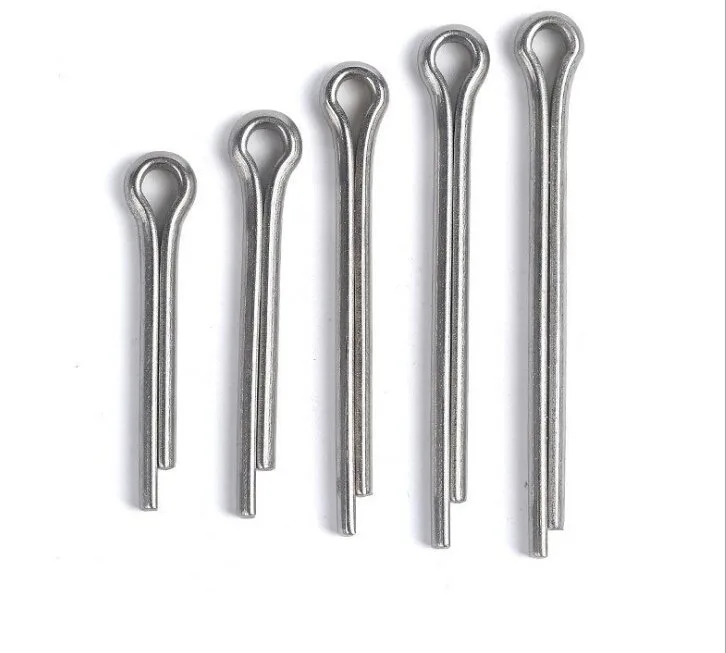
DIN 94 specifies metric split pins, also called cotter pins in North American trade. A split pin is made from folded wire with an eye at one end and two legs at the other. It passes through a drilled hole in a clevis pin, shaft or bolt and the legs are bent after installation to provide positive retention.
The designation DIN 94 remains common on drawings, catalogues and purchase orders, even though current German specifications normally use DIN EN ISO 1234. That commercial use should not be confused with the status of the legacy national document.
For related sizes and geometry, view the DIN 94 split-pin drawing. Product options are available under split pins.
DIN 94 vs ISO 1234
DIN EN ISO 1234 adopts ISO 1234 into the German standards system and is the normal current reference when a new German or European specification requires this product. DIN 94 and ISO 1234 therefore have a much closer relationship than two unrelated national standards for similar pins.
For ordinary commercial replacement, start with the corresponding ISO 1234 nominal diameter and length. Then verify the actual product against the drawing and purchase requirements. This matters because an old drawing may cite a particular DIN edition, may control a non-preferred length or may add material, coating and inspection requirements that are not conveyed by the standard number alone.
Do not rewrite a controlled BOM from DIN 94 to ISO 1234 merely because a supplier lists both numbers on one catalogue page. Record the proposed replacement and obtain the required engineering or customer approval.
Dimensions and requirements to compare
| Check | Why it matters |
|---|---|
| Nominal pin diameter | Establishes the basic size but is not necessarily the maximum actual envelope |
| Actual shank envelope | Determines whether both folded legs pass through the drilled hole |
| Eye width and height | Controls head clearance and seating around nearby components |
| Length definition and available series | Determines whether enough leg projects for correct bending without interference |
| End and leg geometry | Affects insertion, spreading and clearance after installation |
| Dimensional tolerances | Can determine fit in a close or drawing-controlled hole |
| Material and ductility | Must permit installation bending without cracking |
| Surface finish or coating | Controls corrosion protection and can affect the finished envelope |
A label such as “4 mm split pin” is not a complete substitution specification. At minimum, retain the standard, nominal diameter, length, material and finish.
DIN 94 / ISO 1234 vs ASME B18.8.1
DIN 94 and ISO 1234 use a metric dimensional system. ASME B18.8.1 covers American inch-series clevis pins and cotter pins. The inch product is not simply the same pin with its dimensions converted to millimetres: nominal size progressions, tolerances, recommended hole fit, eye geometry and available lengths may differ.
Select an ASME cotter pin from the actual inch-system drawing and the applicable ASME table. For a mixed metric/inch assembly, compare the finished pin envelope and the drilled hole rather than choosing the nearest nominal diameter. A “close” converted size is not enough to authorize substitution.
DIN 94 vs UNI 1336 and JIS B 1351
UNI 1336 is a legacy Italian reference associated with metric split pins. For a new specification, the applicable ISO or EN ISO reference is normally clearer, but an existing UNI-controlled drawing should retain its original requirement until the edition and dimensions have been checked.
JIS B 1351 covers Japanese split pins in a metric product family that can look closely aligned with DIN/ISO products. Do not write JIS B 1351 = DIN 94 without qualification. Confirm the precise nominal size, shank and eye dimensions, tolerance, preferred length series, material and finish before approving a replacement.
Materials, finishes and service conditions
Common commercial split pins are supplied in low-carbon steel, stainless steel and, for particular applications, brass or copper alloys. Plain, zinc-plated and passivated finishes are also encountered. The dimensional cross-reference alone does not select the correct material or corrosion resistance.
Split pins are retaining elements, not property-class bolts. Do not assign bolt classes such as 8.8 or 10.9 to them. Specify the material, coating and any required delivery, inspection or traceability documentation separately.
For a corrosive, elevated-temperature, food-processing, marine or safety-related application, confirm the material and service requirements with the governing design specification. A part that fits the hole is not automatically suitable for the environment.
Installation and reuse
Choose a length that provides enough projection to bend the two legs securely without contacting adjacent moving parts. The pin must pass through the specified hole without being hammered through an undersized opening, and its eye must seat without unwanted interference.
Do not normally reuse a split pin after its legs have been opened and straightened. Installation plastically deforms the wire, and repeated bending can work-harden or crack it. Replace it with a new pin of the approved standard, size, material and finish during reassembly, especially in safety-relevant equipment.
RFQ and substitution checklist
Include the following on an enquiry or purchase order:
- Required standard and edition, if controlled
- Nominal diameter and length
- Drawing-controlled shank, eye or hole dimensions
- Material and required ductility
- Surface treatment and corrosion requirement
- Quantity and packaging
- Inspection certificate and traceability requirements
- Whether an ISO replacement for a DIN drawing has been approved
Example:
Split pin to ISO 1234 (replacement for drawing callout DIN 94), nominal diameter and length as specified, A4 stainless steel, drawing dimensions and substitution approval required.
Frequently asked questions
Is DIN 94 obsolete?
DIN 94 is a legacy German designation. DIN EN ISO 1234 is the current German adoption normally used for new specifications, but DIN 94 remains widely used as a commercial and drawing reference.
Is ISO 1234 identical to DIN 94?
Treat ISO 1234 as the international successor, not as proof that every item from every edition is identical. Verify diameter, length, eye geometry, tolerances, material and finish before substitution.
Can an ASME B18.8.1 cotter pin replace DIN 94?
Not by standard number or approximate size alone. ASME B18.8.1 uses an inch dimensional system; select and approve the part against the actual hole, envelope and inch-system drawing.
Can a split pin be reused?
Normally no. The legs are plastically bent during installation, and straightening and rebending can fatigue or crack the wire. Use a new approved pin during reassembly.
Final recommendation
For a new metric specification, use ISO 1234 or its applicable national adoption. When an existing drawing calls for DIN 94, a corresponding ISO 1234 part is usually the correct replacement candidate, but confirm diameter, length, eye geometry, material, finish and the cited edition before approval. Keep UNI and JIS references tied to their exact documents, and treat ASME B18.8.1 as a separate inch-series system.