Quick answer: what is the ISO equivalent of DIN 603?
ISO 8677:1986 is the historical ISO counterpart to DIN 603 for metric cup-head square-neck bolts with a large head, but ISO 8677 was withdrawn in 2019. DIN 603 remains an active German standard family; DIN Media lists DIN 603:2026-08 as replacing the 2017 edition.
For a current DIN-based specification, keep DIN 603 as the primary reference. Use ISO 8677 only to interpret a legacy drawing or cross-reference, and label it as withdrawn. Do not present DIN EN ISO 8677 as a current German equivalent.
DIN 603 cross-reference at a glance
| Standard | Product and system | Status or relationship | Replacement decision |
|---|---|---|---|
| DIN 603 | Metric cup/mushroom-head square-neck bolt | Current DIN designation; the edition matters | Primary reference for a current DIN requirement |
| ISO 8677:1986 | Metric cup-head square-neck bolt with large head, product grade C | Historical ISO counterpart; withdrawn in 2019 | Use for legacy interpretation, not a new ISO specification |
| UNI 5731 | Italian metric carriage-bolt reference | Related metric national standard | Verify edition and the complete dimensional table |
| JIS B 1171 | Japanese metric round-head square-neck bolt | Related metric national standard | Verify head, neck, thread and length requirements |
| ASME B18.5 | American inch-series round-head/carriage-bolt standard | Different dimensional and thread system | Not a direct DIN 603 replacement |
| ISO 8678 | Metric cup-head square-neck bolt with small head and short neck | Different product configuration | Do not substitute for DIN 603 / ISO 8677 by number similarity |
The cross-reference identifies related standards; it does not prove that every stocked bolt is interchangeable.
What DIN 603 specifies
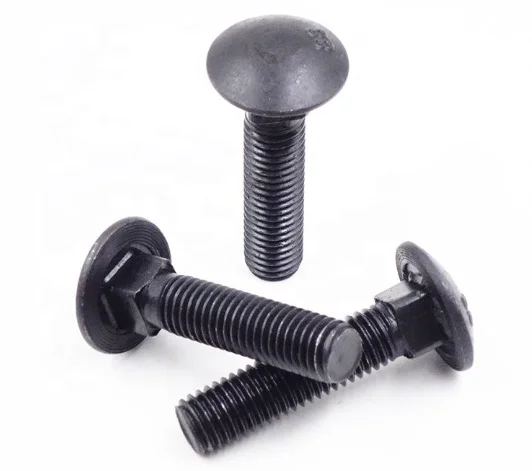
DIN 603 covers the familiar metric carriage bolt, also called a coach bolt, cup-head square-neck bolt or mushroom-head square-neck bolt. Its defining features are:
- A smooth domed or cup-shaped head
- A square neck directly below the head
- A metric threaded shank
- No conventional drive recess in the head
The square neck supplies the anti-rotation function while the nut is tightened from the opposite side. In metalwork it engages a suitably prepared opening; in timber it may embed into the material. A smooth head can reduce snagging and casual access from the head side, but DIN 603 should not be described as a certified security fastener solely for that reason.
View the related DIN 603 drawing and dimensions. For product enquiries, browse bolts and studs.
DIN 603 is current, but the edition changed
Do not label the whole DIN 603 designation as obsolete. DIN Media identifies the previous DIN 603:2017-05 edition as withdrawn and replaced by DIN 603:2026-08. This is a revision of the same standard family, not a change from DIN 603 to another standard number.
That distinction matters on drawings and purchase orders:
- DIN 603 without an edition: confirm which edition the customer expects.
- DIN 603:2017-05: a superseded edition may still govern an existing controlled drawing.
- New DIN requirement: cite the applicable current edition when the contract requires an edition.
Never silently update the edition of a regulated or configuration-controlled drawing. Record the dimensional and technical comparison and obtain the required approval.
DIN 603 vs ISO 8677
DIN 603 and ISO 8677 historically describe the same basic large-head metric carriage-bolt concept: a rounded head, square neck and metric threaded shank. For corresponding sizes and editions, their basic geometry is closely related, which is why catalogues often print both numbers on one product line.
The important current difference is status. ISO 8677:1986 was withdrawn in 2019, while DIN 603 continues as an active DIN standard. Therefore, the technically accurate wording is:
DIN 603 is historically cross-referenced with the withdrawn ISO 8677:1986 standard. ISO 8677 remains useful for interpreting legacy documentation but should not be introduced as a current ISO specification.
Do not show DIN EN ISO 8677 as a current parallel German standard. A supplier's catalogue association does not establish that an EN/DIN adoption remains current.
Dimensions that determine interchangeability
Matching only the nominal thread—for example, M10 or M12—is not enough. Compare:
| Feature | Why it matters |
|---|---|
| Thread diameter, pitch and tolerance | Determines engagement with the specified nut |
| Head diameter | Controls bearing area, coverage and surrounding clearance |
| Head height and profile | Controls projection, seating and envelope |
| Square-neck width | Must engage the prepared hole or surrounding material without excessive play |
| Square-neck height/depth | Determines anti-rotation engagement and stack fit |
| Head-to-neck transition | Can affect seating in a formed or punched opening |
| Nominal length definition | Must be interpreted according to the applicable standard |
| Thread length and unthreaded shank | Affect nut engagement, shear plane and grip |
| Product grade and tolerances | Affect dimensional fit and acceptance |
The controlled standard or drawing must supply the acceptance limits. Keep exact dimensional tables on the DIN 603 drawing page instead of treating approximate catalogue values as universal substitution limits.
Why the square neck is the critical feature
The square neck is the bolt's drive mechanism. If it cannot resist rotation, the nut may become impossible to tighten or remove.
A spinning carriage bolt commonly indicates one of these problems:
- The square-neck width does not match the prepared opening.
- A round or oversized hole provides insufficient engagement for the application.
- The sheet-metal hole has deformed or worn.
- Timber around the neck has crushed, softened or enlarged.
- The coating or burr prevents the head and neck from seating correctly.
- The replacement standard uses different neck height or transition geometry.
Do not solve the problem by checking thread size alone. Compare neck width, neck height, hole preparation, material thickness and the available bearing area. The joint design determines whether the neck should engage a square hole, a formed opening or timber.
DIN 603 vs ISO 8678
ISO 8678 is not the current replacement for withdrawn ISO 8677. It covers a different cup-head square-neck configuration with a small head and short neck. These differences can change bearing area, surface coverage and anti-rotation engagement.
Do not substitute ISO 8678 for DIN 603 simply because the numbers are adjacent or both products are described as carriage bolts. Compare the exact head and neck form specified by the drawing.
DIN 603 vs ASME B18.5
ASME B18.5 is an American inch-series standard. It uses inch nominal sizes and Unified threads, whereas DIN 603 uses metric dimensions and ISO metric threads. The head and square-neck tables, length conventions, tolerances and strength designations also belong to different systems.
Consequently, an ASME B18.5 carriage bolt is not a direct DIN 603 replacement even when an inch diameter looks numerically close to a metric size. Verify:
- Actual thread diameter, pitch and thread form
- Head and square-neck dimensions
- Hole geometry and material engagement
- Grip and thread length
- Mechanical strength requirements
- Material and coating
Historical metric ASME carriage-bolt documents may also appear in catalogues. Treat the precise document and status as a separate comparison; do not shorten a metric designation to “ASME B18.5” and imply interchangeability.
DIN 603 vs UNI 5731 and JIS B 1171
UNI 5731 is commonly used as an Italian metric carriage-bolt cross-reference. JIS B 1171 covers Japanese metric round-head square-neck bolts. Both are more meaningful comparison candidates than an inch-series ASME bolt because they describe metric threaded products with the same basic anti-rotation concept.
They are still not automatic replacements. Confirm the cited editions and compare head diameter, head height, neck width, neck height, transition geometry, thread, nominal length, thread length and product tolerances. This is especially important when the neck fits a pre-punched metal opening or a tightly controlled bracket.
Property class, material and coating
DIN 603 is primarily a product and dimensional standard. The geometry designation alone does not supply a complete mechanical specification. Preserve the property class stated on the drawing or order and verify it against the applicable mechanical-property standard.
For example, a callout such as DIN 603 M12 × 80 — 8.8 includes requirements that are lost if a supplier quotes only “ISO 8677 M12 × 80.” The replacement must retain the approved property class as well as the geometry.
Common commercial materials and finishes include carbon steel, stainless steel, electroplated zinc and hot-dip galvanizing, but availability is not equivalence. Coating thickness can affect square-neck fit, thread engagement and hole clearance. Specify material, property class, coating system, corrosion requirement and inspection documentation separately.
There is no universal DIN 603 temperature limit. Temperature suitability depends on material, heat treatment, coating, preload, corrosion environment and the governing joint design.
Interchangeability decision matrix
| Proposed replacement | General assessment | Required action |
|---|---|---|
| Current DIN 603 edition ↔ older DIN 603 drawing | Same standard family, different editions | Compare revision changes and obtain drawing approval |
| ISO 8677 → DIN 603 | Common historical-to-current DIN conversion | Confirm dimensions, edition, property class and coating |
| DIN 603 → ISO 8677 | Historical geometry may correspond, but ISO is withdrawn | Do not introduce ISO 8677 as a new current specification |
| UNI 5731 → DIN 603 | Related metric product | Compare controlled dimensional and mechanical requirements |
| JIS B 1171 → DIN 603 | Related metric product | Check head, neck, thread, length and tolerance tables |
| ASME B18.5 → DIN 603 | Inch versus metric systems | Not a direct replacement; redesign or documented approval may be required |
| ISO 8678 → DIN 603 | Different small-head/short-neck configuration | Do not treat as an equivalent |
RFQ and purchase-order checklist
Include:
- Standard and edition
- Nominal diameter, pitch and length
- Required thread length or grip
- Head diameter and head height when drawing-controlled
- Square-neck width, height and mating-hole requirement
- Product grade and mechanical property class
- Material and coating
- Corrosion and service requirements
- Inspection certificate and traceability
- Approval reference for any standard or edition conversion
Example:
DIN 603:2026-08 carriage bolt, M12 × 80, property class 8.8, zinc-flake coating; square-neck and thread-length dimensions to drawing, inspection certificate required.
Frequently asked questions
Is ISO 8677 still current?
No. ISO 8677:1986 was withdrawn in 2019. It remains a useful historical cross-reference to DIN 603 but should not be presented as a current ISO standard.
Is DIN 603 obsolete?
No. The DIN 603 standard family remains active. DIN Media lists DIN 603:2026-08 as replacing DIN 603:2017-05; always check the edition required by the drawing.
Is a coach bolt the same as a carriage bolt?
Usually yes in this context. “Carriage bolt,” “coach bolt” and “cup-head square-neck bolt” are regional or technical names for the same general product form, but the standard number still determines the exact geometry.
Why does a DIN 603 bolt spin while tightening?
The square neck is not engaging the hole or surrounding material adequately. Check neck width and height, hole shape and size, sheet deformation, timber condition, coating build-up and correct seating.
Can ASME B18.5 replace DIN 603?
Not directly. ASME B18.5 is an inch/Unified-thread system with its own head, neck and strength requirements. A numerically close diameter does not establish thread or dimensional compatibility.
Can ISO 8678 replace ISO 8677 or DIN 603?
No automatic replacement should be made. ISO 8678 covers a different small-head, short-neck product configuration.
Final recommendation
Use the applicable current DIN 603 edition for a new DIN-based carriage-bolt requirement. Treat ISO 8677:1986 as a withdrawn historical counterpart, not a current ISO alternative, and do not publish DIN EN ISO 8677 as a current equivalent. For any UNI, JIS, ASME or edition change, verify thread, head, square neck, length, property class, material and coating before approving substitution.