Quick answer: what replaced DIN 6921?
DIN 6921:1983-06 is withdrawn. DIN EN 1665 is its formal German/European successor for heavy-series hexagon bolts with flange, but it must not be treated as an edition-neutral, dimension-for-dimension renumbering. ISO 4162 is a related current international small-series flange-bolt standard, not the formal DIN successor and not a blanket dimensional equivalent.
The remaining regional references are useful for purchasing searches, but each has its own status and geometry:
| Reference | Status and relationship to DIN 6921 |
|---|---|
| DIN 6921 | Withdrawn German legacy hexagon flange-bolt standard; still common on drawings, catalogues and RFQs |
| DIN EN 1665 | Formal German/European successor route; heavy series, but verify the exact size and edition before replacement |
| ISO 4162 | Current related international small series; similar function, different head/flange envelope and reduced size range |
| ASME B18.2.3.4M | Withdrawn US metric flange-screw standard, historically close to the ISO 4162 family |
| JIS B 1189 | Current Japanese flange-bolt family with ISO-based and edition/configuration-specific requirements |
Why these standards can be cross-referenced
All four product families describe a metric fastener with:
- an external hexagon drive;
- an integral circular flange under the head;
- a larger bearing surface than a conventional hex head alone;
- applications where fewer loose washers and faster assembly are valuable.
That common function is why buyers search the standards together. It is not proof of identical width across flats, head height, flange diameter, bearing-face form, thread range, thread length, property class or finish.
DIN 6921 and ISO 4162 have different head envelopes
The following representative values are useful for identifying the two families. They are not a substitute for the controlled table in the cited edition.
| Size | DIN 6921 WAF s |
ISO 4162 WAF s |
DIN 6921 flange dᶜ |
ISO 4162 flange dᶜ |
DIN 6921 head k |
ISO 4162 head k |
|---|---|---|---|---|---|---|
| M5 | 8 mm | 7 mm | 11.8 mm | 11.4 mm | 5.4 mm | 5.6 mm |
| M6 | 10 mm | 8 mm | 14.2 mm | 13.6 mm | 6.6 mm | 6.8 mm |
| M8 | 13 mm | 10 mm | 18.0 mm | 17.0 mm | 8.1 mm | 8.5 mm |
| M10 | 15 mm | 13 mm | 22.3 mm | 20.8 mm | 9.2 mm | 9.7 mm |
| M12 | 16 mm | 15 mm | 26.6 mm | 24.7 mm | 11.5 mm | 12.1 mm |
| M14 | 18 mm | 18 mm | 30.5 mm | 28.6 mm | 12.8 mm | 12.9 mm |
| M16 | 21 mm | 21 mm | 35.0 mm | 32.8 mm | 14.4 mm | 15.2 mm |
The clearest procurement example is M10:
- legacy DIN 6921: approximately
15 mm WAF / 22.3 mm flange / 9.2 mm head; - ISO 4162: approximately
13 mm WAF / 20.8 mm flange / 9.7 mm head.
The thread may fit while the existing socket, counterbore, adjacent clearance or bearing area does not. At M12, the difference remains visible: 16 mm versus 15 mm WAF and approximately 26.6 mm versus 24.7 mm flange diameter.
DIN EN 1665 is the successor, not an automatic identical part
DIN formally routes DIN 6921 to DIN EN 1665. That establishes standards succession; it does not erase edition-specific technical changes. For a legacy drawing, compare at least:
- width across flats and corner envelope;
- head height and flange diameter/thickness;
- bearing-face form and any underhead radius;
- thread range, pitch and thread length;
- property class and material coverage;
- product grade, tolerances, coating and inspection.
EN 1665 dimensions are size- and edition-specific, so a general claim that a fixed list of wrench sizes either changed or remained identical is not adequate for acceptance. Compare the exact DIN 6921 and DIN EN 1665 editions for the requested diameter.
Likewise, a legacy fine-pitch or class 12.9 callout is not automatically within the scope of a current EN 1665 purchase. Keep the complete original designation and obtain approval for any standards conversion.
ISO 4162 is a small series, not “new DIN 6921”
ISO 4162 covers the same general product concept using a smaller head/flange envelope. Its basic size range stops at M16, while legacy DIN 6921 includes M20. Therefore DIN 6921 M20 → ISO 4162 M20 is not a valid direct mapping.
For M5–M16, compare the dimensional table rather than replacing only by diameter and length. A callout such as M12 × 50 DIN 6921 does not become compliant merely by shipping M12 × 50 ISO 4162.
ASME B18.2.3.4M is a withdrawn historical reference
ASME B18.2.3.4M covered metric hex flange screws and was historically closely aligned with the ISO 4162 dimensional family. It has been withdrawn, and ISO 4162 is commonly identified in the supersession route.
Keep the ASME number on the cross-reference page because it remains present on legacy US drawings and purchasing databases. Do not describe it as a current standard or as an exact DIN 6921 equivalent. Confirm the ASME edition, size, pitch, dimensions, mechanical specification and coating before converting the callout.
JIS B 1189 is related, not “DIN 6921 in Japanese”
JIS B 1189 covers Japanese hexagon flange bolts and contains edition- and configuration-specific requirements, including ISO-based forms. Its common M5–M16 products may resemble other ISO flange-bolt families, but the JIS number alone does not prove DIN 6921 head geometry.
Confirm the JIS type/annex, coarse or fine pitch, WAF, flange diameter, head height, thread length, strength designation and finish. This is especially important when a catalogue lists only JIS B 1189 without identifying the applicable form.
Plain or serrated flange: the RFQ must say
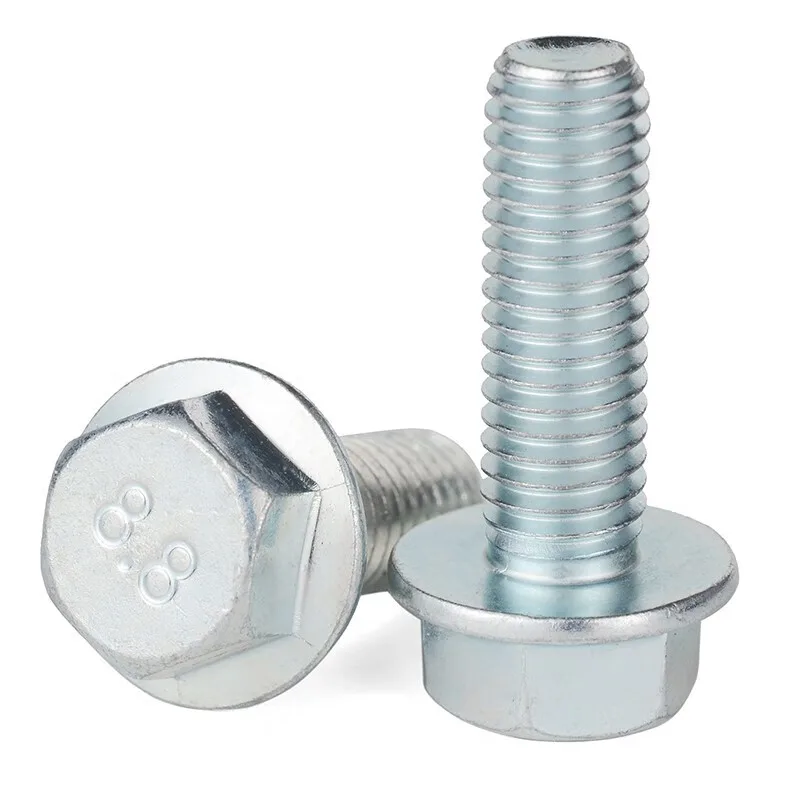
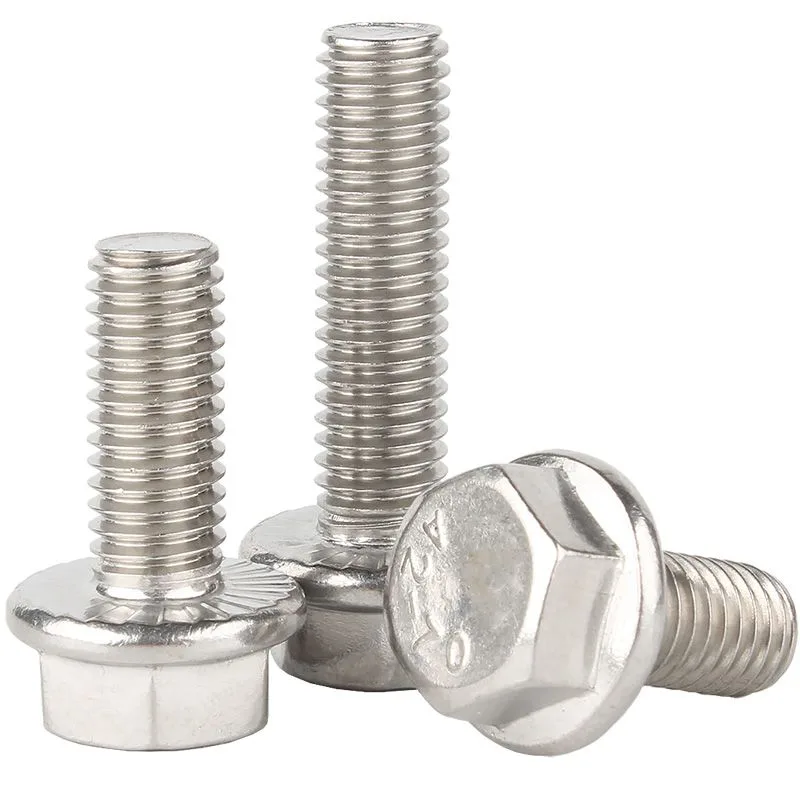
DIN 6921 alone should not be interpreted as an unconditional serration requirement. The controlled product is commonly understood as a plain-bearing-face hex flange bolt. Suppliers also market serrated flange products using DIN 6921-style geometry or search wording, which creates a frequent commercial ambiguity.
Specify one of these explicitly:
- plain/non-serrated bearing face for controlled seating and minimal surface marking;
- serrated underhead face when the approved joint design requires mechanical bite and added resistance to rotation.
Serrations change bearing friction, surface damage, tightening behaviour and removability. They are not a universal substitute for an engineered prevailing-torque nut, thread-locking system or validated vibration-resistant joint.
Does the flange replace a washer?
The integral flange spreads load over a larger area, so a separate flat washer is often unnecessary. But “hex bolt plus loose washer” is not automatically equivalent to a flange bolt: bearing diameter, stack height, contact pressure, friction and installation behaviour can differ.
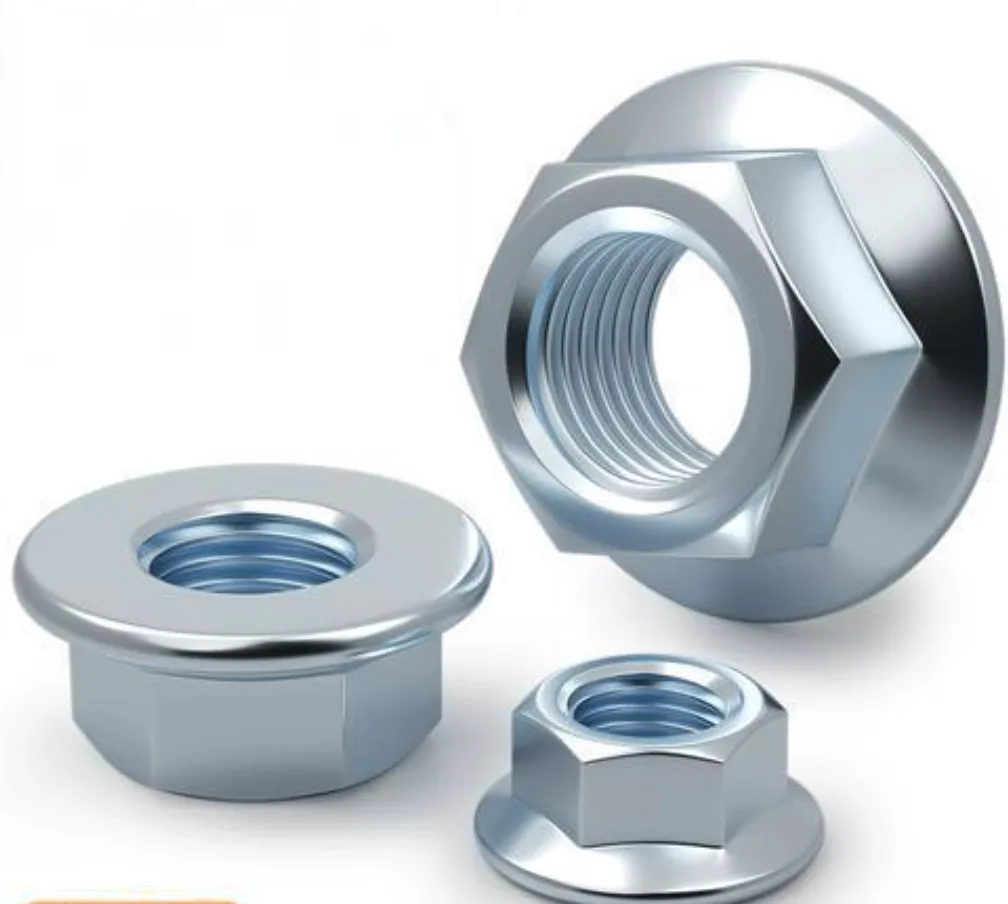
The mating nut is also specified separately. Match thread diameter and pitch, nut type, property class, material, coating and joint requirements; DIN 6921 is not a complete bolt-and-nut assembly standard.
Material, coating and temperature still matter
The dimensional standard number alone does not establish a universal operating temperature. Temperature capability depends on steel or stainless grade, property class, heat treatment, coating, preload, environment and joint design.
Plain/oiled, electroplated zinc, zinc-flake, hot-dip galvanized and other finishes can change thread fit and the torque/preload relationship. Retain the finish and lubrication requirements when considering a cross-standard replacement.
RFQ and replacement checklist
For a legacy callout such as DIN 6921 – M12 × 50 – 10.9 – zinc flake, confirm:
- DIN 6921 edition and whether conversion to DIN EN 1665 is approved.
- Diameter, pitch, length, thread length and unthreaded shank.
- WAF
s, head heightk, flange diameterdᶜand flange thickness. - Plain or serrated underhead surface; never infer it from a catalogue photo.
- Bearing face, underhead radius, corner envelope and surrounding clearance.
- Steel/stainless grade, property class and heat-treatment requirements.
- Coating, lubrication, corrosion class and torque/preload controls.
- Compatible nut and whether a separate washer is permitted.
- Whether ISO, ASME or JIS is only a sourcing reference or an approved substitute.
- Inspection documents, lot traceability and any customer drawing dimensions.
Purchasing conclusion
DIN 6921 remains a valuable legacy search and procurement designation, but DIN EN 1665 is its formal German/European successor. ISO 4162 is a related small-series standard, withdrawn ASME B18.2.3.4M is a historical US reference, and JIS B 1189 is a related Japanese family. They can stay together in a purchasing cross-reference only when the article also states the concrete differences. Approve substitution by the cited editions, head/flange dimensions, thread, property class, underhead face and finish—not by nominal M size alone.