DIN 7991: Hexagon Socket Countersunk Head Screws
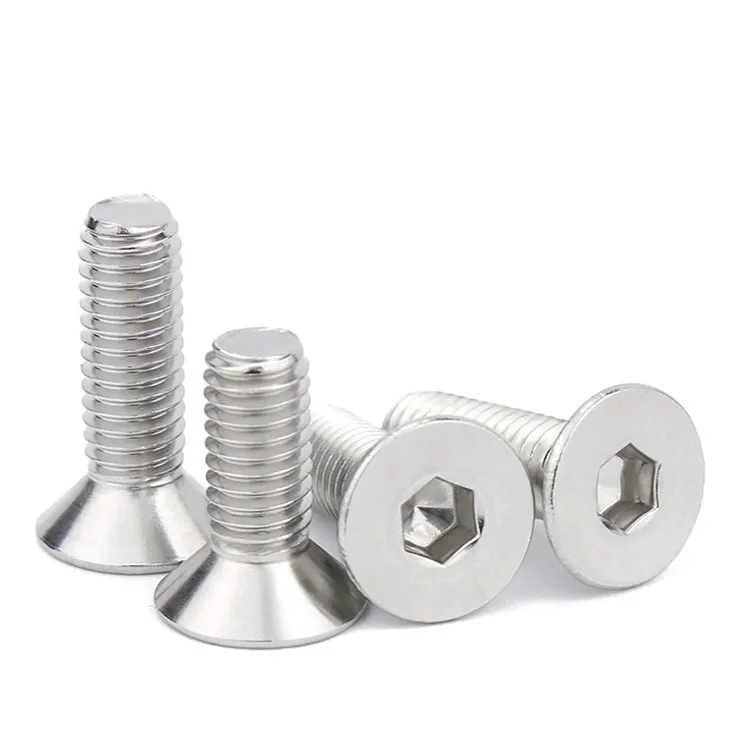
DIN 7991 is the legacy German designation for metric hexagon socket countersunk head screws. The conical head is designed to sit flush with a matching countersunk hole, making this product common in machine covers, fixtures, sliding parts, panels and assemblies where a projecting head is unacceptable.
The current international reference is ISO 10642; DIN EN ISO 10642 is the German adoption. DIN 7991 remains widely used on drawings and in trade, so both designations are relevant when sourcing replacement parts.
Browse stainless countersunk socket screws for A4-80 / SS316 supply options.
DIN 7991 Equivalent Standards
| System | Reference | Practical position |
|---|---|---|
| ISO | ISO 10642 | Main current international reference |
| DIN EN ISO | DIN EN ISO 10642 | German adoption of ISO 10642 |
| China | GB/T 70.3 | Corresponding Chinese metric countersunk socket screw standard |
| United States | ASME B18.3.5M | Metric hexagon socket flat countersunk head cap screw standard |
| Italy | UNI 5933 | Legacy Italian reference for the same product family |
| Japan | JIS B 1194 | Japanese countersunk socket screw reference |
The main migration path is:
DIN 7991 → ISO 10642 → DIN EN ISO 10642
The national references above help interpret a drawing or source regional stock. They are not permission to assume every edition, tolerance, material rule or inspection requirement is identical.
The Critical Dimension: Countersunk Head Angle
For a countersunk screw, correct thread diameter alone is not enough. The conical bearing surface must match the countersink in the part.
Metric DIN 7991 / ISO 10642-type screws use a 90° head angle through M20 and a 60° head angle from M22 upward. This differs from the common inch-series ASME countersunk socket screw, which uses an 82° head angle.
An 82° countersink with a 90° metric screw will not seat over its full conical surface. The head can sit proud or contact only near an edge, reducing bearing area and potentially affecting clamp load or damaging thin and brittle material. Do not treat metric and inch countersunk screws as substitutes merely because their nominal diameters look similar.
DIN 7991 vs ISO 10642
ISO 10642 is the principal modern counterpart to DIN 7991. Commercial stock is often described as DIN 7991 / ISO 10642, and that is generally useful for standard industrial purchasing.
For a controlled replacement, compare:
| Check | Why it matters |
|---|---|
| Diameter, pitch and thread tolerance | Mating-thread compatibility |
| Head diameter and head height | Counterbore and flush seating |
| Countersunk angle | Full contact with the mating cone |
| Socket size and minimum depth | Tool engagement and installation torque |
| Thread length and nominal length | Clamp stack and engagement |
| Material and property class | Strength and corrosion performance |
| Coating and lubrication | Corrosion protection and torque-tension behavior |
Old DIN 7991 data sheets and current ISO 10642 tables may not express every requirement in the same way. For a close-tolerance countersink, use the governing drawing and the cited standard edition rather than a generic internet table.
GB/T 70.3 and ASME B18.3.5M
GB/T 70.3 is the Chinese reference for metric countersunk socket screws and is useful when a Chinese drawing or supplier documentation is involved. Confirm the cited edition, dimensions and property requirements before contractual substitution.
ASME B18.3.5M is the relevant American metric standard for hexagon socket flat countersunk head cap screws. It must not be confused with ASME B18.3.4M, which covers metric button-head socket screws rather than a flush countersunk head. When an American metric callout is proposed as a DIN 7991 alternative, compare the head angle, head diameter, head height, socket depth, thread length and tolerances.
Countersunk Screws Are Not Socket Head or Low-Head Screws
| Standard | Head form | Can it replace DIN 7991? |
|---|---|---|
| DIN 912 / ISO 4762 | Cylindrical socket head | No — head projects above the surface |
| DIN 7984 | Low cylindrical socket head | No — different seating geometry and loadability |
| DIN 965 | Countersunk cross-recess screw | Not automatically — drive and product requirements differ |
Changing the head type requires a new or approved mounting-hole design. A DIN 912 screw cannot become flush in a DIN 7991 countersink, and a low-head screw is not a countersunk replacement.
Strength Class: A Countersunk-Head Caveat
The standard number mainly identifies the product geometry. State material, property class and finish separately: for example 8.8, 10.9, 12.9, A2-70 or A4-80.
Because a countersunk head has less load-bearing section than a cylindrical socket head, do not automatically assume that a DIN 7991 / ISO 10642 screw has the same tensile capacity as a DIN 912 / ISO 4762 screw of the same diameter and stated property class. For a tension-critical joint, use the governing mechanical requirements and request applicable test data from the supplier.
RFQ Checklist
Specify the standard and edition, diameter, pitch, length, material, property class, finish, thread tolerance, required head angle, critical head dimensions, quantity and inspection documents. For example:
ISO 10642 / DIN 7991 countersunk socket screw, M8 × 30, 90° head, property class 10.9, black oxide, thread tolerance 6g, inspection certificate required.
For stainless steel:
DIN 7991 / ISO 10642 countersunk socket screw, M6 × 20, A4-80, passivated, flush mounting in a 90° countersink, lot traceability required.
Related Resources
- DIN / ISO / ASME / JIS cross-reference chart
- DIN 912 vs ISO 4762 socket head cap screws
- DIN 7984 low-head socket screw reference
- Stainless countersunk socket screws
- Industrial equipment fasteners
Use this page as a sourcing guide. For safety-critical or drawing-controlled work, the applicable standard edition, part drawing and engineering approval govern the substitution.