Quick answer: can ISO 4026 replace DIN 913?
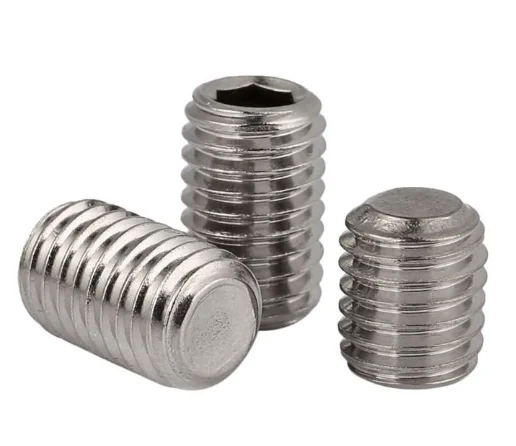
Yes. ISO 4026 is the correct successor standard for a DIN 913 headless hexagon-socket set screw with flat point. DIN 913:1980-12 is withdrawn, and the current 2026 standards chain is:
DIN 913:1980-12 → DIN EN ISO 4026:2004-05 → DIN EN ISO 4026:2026-06 / ISO 4026:2026
The 2004 DIN EN ISO edition and ISO 4026:2003 are also superseded. For a controlled substitution, preserve the flat-point form and verify thread diameter, pitch, length, socket dimensions, point geometry, material or hardness class, coating and cited edition.
DIN 913 cross-reference at a glance
| Standard | Product or scope | Status / relationship | Replacement decision |
|---|---|---|---|
| DIN 913:1980-12 | Hexagon socket set screw with flat point | Withdrawn DIN standard | Legacy drawing reference |
| ISO 4026:2026 | Metric coarse-thread hexagon socket set screws with flat point | Current ISO standard | Primary current international reference |
| DIN EN ISO 4026:2026-06 | German adoption of current ISO 4026 | Current DIN/EN/ISO reference | Preferred for a new German specification |
| ASME B18.3.6M | Metric hexagon socket flat-point set-screw reference | Corresponding ASME document; edition/status must be checked | Compare dimensions and material system before substitution |
| UNI 5923 | Italian flat-point hexagon socket set-screw reference | Legacy/withdrawn national standard | Verify thread pitch, especially legacy fine-thread callouts |
| JIS B 1177 | Japanese hexagon socket set-screw standard covering multiple point types | Broader than ISO 4026 alone | Specify the flat-point type and exact edition |
The table identifies the correct product family. It does not make every item carrying one of these numbers automatically identical.
What DIN 913 specifies
DIN 913 covers a headless, internally hexagon-driven set screw with a flat point. The threaded body is installed flush with or below the surrounding surface, and the point bears against a shaft or mating component.
Typical uses include positioning collars, hubs, gears and pulleys; limiting relative movement; and applying radial clamping contact to a shaft. The flat point spreads contact over a broader area than a cone point and normally penetrates less aggressively than a cup point. It can still mark or deform a surface when contact pressure is high, so “flat point” does not mean “no surface damage.”
View the DIN 913 drawing and dimensions, or browse related engineering screws.
Current standard and edition history
The editions matter because ISO 4026 was revised in 2026:
| Document | Status |
|---|---|
| DIN 913:1980-12 | Withdrawn; replaced in the DIN system by DIN EN ISO 4026 |
| ISO 4026:2003 | Withdrawn; superseded by ISO 4026:2026 |
| DIN EN ISO 4026:2004-05 | Withdrawn; superseded by DIN EN ISO 4026:2026-06 |
| ISO 4026:2026 | Current ISO edition |
| DIN EN ISO 4026:2026-06 | Current German adoption |
ISO 4026:2026 covers metric coarse-pitch threads from M1.6 to M30 for steel and M1.6 to M24 for stainless steel, product grade A. The former 2003 ISO edition covered up to M24. Therefore, an M27 or M30 steel product belongs to the expanded current scope, not the old 2003 range.
Do not silently update a controlled drawing from an old edition. Confirm revision differences, purchasing requirements and approval status.
DIN 913 vs ISO 4026: what must match?
The product has no conventional head, so head diameter and head height are not the relevant comparison fields. Check:
| Feature | Why it matters |
|---|---|
| Point type | Must remain flat point; another point changes contact and locking behaviour |
| Thread diameter and pitch | Controls engagement and determines whether a legacy fine pitch falls outside current ISO scope |
| Thread tolerance | Affects assembly, prevailing fit and inspection |
| Nominal length and length tolerance | Controls installed depth and point position |
| Hexagon socket size | Determines the correct key and torque-transfer interface |
| Socket depth and geometry | Affect tool engagement and stripping resistance |
| Flat-point diameter and end form | Determine contact area and local bearing pressure |
| Product grade | Controls dimensional tolerances |
| Material and hardness class | Determine point and socket deformation resistance |
| Coating | Affects corrosion, thread fit and high-hardness process risks |
Use the controlled edition for acceptance limits. Keep exact dimension values on the DIN 913 drawing page, rather than treating a distributor table as a universal substitution specification.
Do not mix DIN 913 with DIN 914, DIN 915 or DIN 916
The four common hexagon-socket set-screw standards differ mainly at the working end:
| Legacy DIN | Current ISO comparison | Point form | Typical functional distinction |
|---|---|---|---|
| DIN 913 | ISO 4026 | Flat point | Broad contact; reduced penetration compared with more aggressive points |
| DIN 914 | ISO 4027 | Cone point | Concentrated contact and intentional indentation/centering |
| DIN 915 | ISO 4028 | Dog point | Positive location in a matching hole or slot |
| DIN 916 | ISO 4029 | Cup point | Rim contact that bites into the mating surface |
A dog point is not simply a “stronger-grip flat point”: it normally depends on a mating recess, hole or slot for location. A cup or cone point may grip through penetration but will mark the surface more readily. The designer must select the point form from the required contact and movement, not from thread size alone.
Related comparisons: DIN 914 / ISO 4027, DIN 915 / ISO 4028 and DIN 916 / ISO 4029.
Thread scope and legacy fine pitches
Current ISO 4026:2026 explicitly specifies metric coarse-pitch threads. Older national documentation can include a different range, and UNI 5923 references are encountered with both coarse and fine pitches.
If a legacy callout states a pitch—for example, M12 × 1.5 DIN 913—do not replace it with an unqualified coarse-thread ISO 4026 product. Retain the full thread designation and determine whether the part is a special or is governed by another approved specification.
The same caution applies to length: a diameter and pitch match does not confirm that the required length, socket depth and point location are available in the current standard range.
Hardness class is not bolt property class
Do not specify a DIN 913 / ISO 4026 set screw as “8.8,” “10.9” or “12.9” merely by copying a bolt property class. Steel set screws use the hardness-class framework applicable to set screws and similar fasteners not under tensile stress, while stainless products use the applicable stainless-steel grade and property requirements.
45H is a common commercial hardness class, but DIN 913 or ISO 4026 does not mean that every product is automatically 45H. Other approved hardness classes or stainless-steel grades may apply. State the required class or grade explicitly and use the relevant mechanical-property standard, such as ISO 898-5 for carbon/alloy steel or ISO 3506-3 for corrosion-resistant stainless steel.
A coating is also not a cosmetic afterthought. On hardened steel set screws, cleaning and electroplating processes may require hydrogen-embrittlement controls under the governing coating specification. Coating build-up can change thread and socket fit. Specify the finish, corrosion requirement and process documentation separately.
What “not intended for tensile load” means
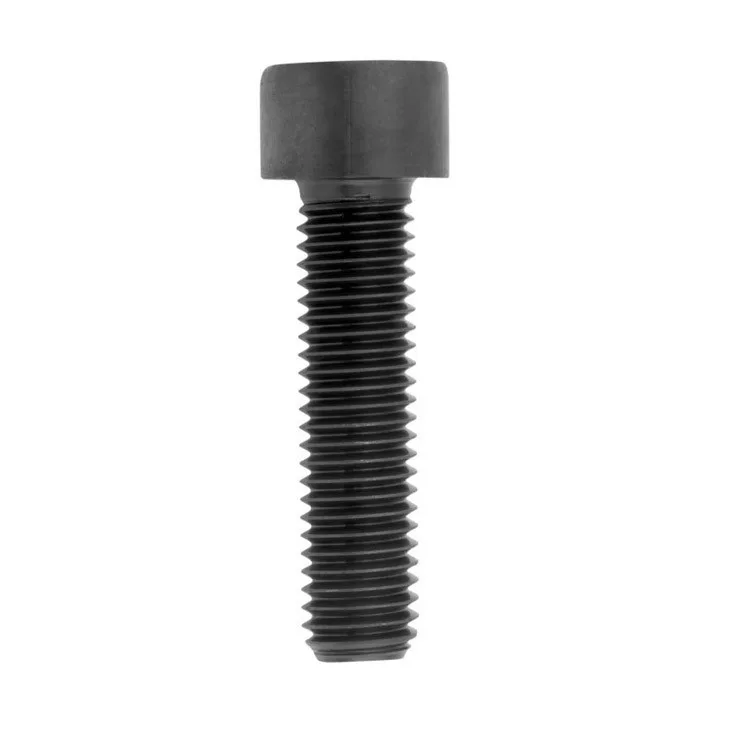
ISO 4026 states that set screws are not intended for tensile loading. A headless set screw should not be used like a conventional bolt whose body carries an axial tensile preload between a head and nut.
This statement should not be confused with movement of the shaft being secured. A radially installed set screw can contribute to resisting rotational or axial movement of a shaft through friction, point contact or engagement with a prepared feature. The capacity depends on tightening force, point geometry, shaft material, mating feature, number of screws and the complete joint design; the ISO product designation alone does not provide a universal holding-load rating.
For a safety-critical torque or axial-retention requirement, calculate and test the joint or use a positive feature such as a key, pin, shoulder, groove or engineered locking assembly as required by the design authority.
DIN 913 vs ASME B18.3.6M
ASME B18.3.6M is a metric flat-point socket-set-screw comparison, so it is more relevant than an inch-series set-screw standard. It still must not be described as an unconditional dimension-for-dimension identity.
Check the exact ASME edition and status, then compare thread, length convention, socket size and depth, point dimensions, tolerances, material and hardness requirements. “Metric” establishes a common unit and thread family; it does not prove complete contractual equivalence.
DIN 913 vs UNI 5923 and JIS B 1177
UNI 5923 is a strong historical Italian cross-reference for the flat-point product. Its legacy fine-thread provisions are an important exception to the coarse-thread scope of current ISO 4026, so the full thread callout must be retained.
JIS B 1177 is broader: it covers multiple hexagon-socket set-screw point types corresponding to the ISO 4026–4029 family. A valid DIN 913 comparison must specify JIS B 1177, flat-point type, then verify the edition, dimensions, material and any JIS-specific requirements. “JIS B 1177” alone does not prove that the supplied screw has a flat point.
Installation and socket-damage risks
Use the exact, undamaged hex key size and ensure full tool engagement. Small sockets are particularly sensitive to worn tools, angled driving and excessive torque. A nominal socket size does not create a universal tightening torque; torque depends on size, material, hardness, coating, lubrication, mating thread and required contact force.
Before installation, confirm that the tapped hole provides the required engagement and depth, that the screw will not bottom prematurely, and that the flat point reaches the intended contact surface. Avoid using a damaged socket as evidence that another point type or higher torque is required—the joint and installation method should be reviewed first.
There is no universal DIN 913 / ISO 4026 temperature rating. Temperature capability follows from the actual material, hardness, coating, lubrication, mating materials and environment.
Interchangeability decision matrix
| Proposed replacement | General assessment | Required action |
|---|---|---|
| DIN 913 → current ISO 4026 / DIN EN ISO 4026 | Correct successor path | Confirm flat point, thread, length, socket, class/grade and coating |
| ISO 4026:2003 → ISO 4026:2026 | Same standard family, revised scope | Check edition changes, especially larger steel sizes |
| UNI 5923 → ISO 4026 | Strong historical comparison | Verify coarse versus fine pitch and all dimensions |
| JIS B 1177 → ISO 4026 | Depends on the selected JIS point type | Require flat point and compare the controlled edition |
| ASME B18.3.6M → ISO 4026 | Corresponding metric product | Compare exact dimensions and mechanical framework |
| DIN 914 / 915 / 916 → DIN 913 | Different point function | Do not substitute without engineering approval |
RFQ and purchase-order checklist
Include:
- Current standard and edition
- Flat-point designation
- Thread diameter, pitch and tolerance
- Overall length
- Socket size/depth when drawing-controlled
- Point dimensions when application-critical
- Steel hardness class or stainless-steel grade
- Surface treatment and hydrogen-embrittlement controls where applicable
- Quantity, inspection certificate and traceability
- Approval reference for a legacy-standard conversion
Example:
Hexagon socket set screw with flat point, ISO 4026:2026, M12 × 20 coarse thread, hardness class 45H, specified coating and inspection documentation; approved replacement for DIN 913 drawing callout.
Frequently asked questions
Is DIN 913 obsolete?
DIN 913:1980-12 is withdrawn. Its current successor is DIN EN ISO 4026:2026-06, based on ISO 4026:2026. DIN 913 remains widely used as a legacy trade and drawing designation.
What changed in ISO 4026:2026?
The current edition extends the coarse-thread steel range to M30, while stainless steel remains covered to M24. The previous ISO 4026:2003 edition covered up to M24.
Does DIN 913 always mean 45H?
No. 45H is common for hardened steel products, but the dimensional standard alone does not make every screw 45H. Specify the hardness class or stainless-steel grade separately.
Can DIN 916 replace DIN 913?
Not automatically. DIN 916 / ISO 4029 has a cup point that bites into the surface; DIN 913 / ISO 4026 has a flat point with different contact behaviour.
Is JIS B 1177 equivalent to DIN 913?
Only its flat-point configuration is the relevant comparison. JIS B 1177 covers several point types, so the type, edition and dimensions must be stated.
Can a set screw resist axial movement of a shaft?
It may contribute through friction or point engagement, but ISO 4026 provides no universal axial holding rating. Do not confuse shaft retention with using the screw itself as a tensile-loaded bolt; design and verify the complete joint.
Final recommendation
For a new specification, use ISO 4026:2026 or DIN EN ISO 4026:2026-06. Treat DIN 913, ISO 4026:2003 and DIN EN ISO 4026:2004 as legacy references. Preserve the flat point and verify thread, length, socket, point geometry, hardness or stainless grade, coating and load case before approving a replacement.