
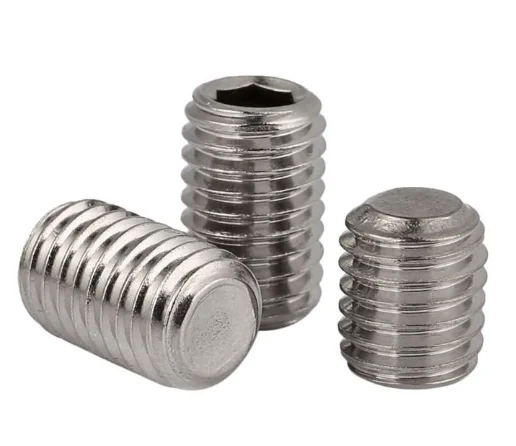
DIN 913 Flat Point Set Screws
| Standard | DIN 913 · ISO 4026 |
|---|---|
| Material | Carbon Steel / Alloy Steel |
| Strength Grade | 14H / 22H / 33H / 45H |
| Size Range | M1.6-M24 |
| Surface Treatment | Black Oxide / Zinc Plated / Zinc Flake |
| Standard | DIN 913 · ISO 4026 |
|---|---|
| Material | Carbon Steel / Alloy Steel |
| Strength Grade | 14H / 22H / 33H / 45H |
| Size Range | M1.6-M24 |
| Surface Treatment | Black Oxide / Zinc Plated / Zinc Flake |
Product Description
DIN 913 specifies a headless, fully threaded set screw with an internal hexagon drive and flat point. It installs flush with or below the surrounding surface and applies radial clamping or positioning contact to a shaft, collar, hub, gear, pulley or mating component.
The flat point spreads contact across a broader area than a cone point and normally penetrates less aggressively than cone- or cup-point alternatives. It may still mark a soft shaft under high contact pressure, so the mating material, tightening method and required holding function must be considered.
DIN 913 is the legacy designation and ISO 4026 is its current successor family. Confirm thread, length, socket, point geometry, hardness class and coating against the controlled edition. Do not specify ordinary bolt classes such as 8.8, 10.9 or 12.9 for this product; set screws use the applicable hardness-class system.
| Product type | Headless hexagon socket set screw with flat point |
|---|---|
| Standard | DIN 913 / ISO 4026 |
| Material | Carbon steel / alloy steel |
| Hardness class | 14H / 22H / 33H / 45H |
| Size range | M1.6-M24 |
| Thread | Metric coarse thread; special pitch only by approved drawing |
| Drive | Internal hexagon socket |
| Point | Flat point |
| Surface finish | Black oxide / zinc plated / zinc flake |
| Inspection | Thread, length, socket, point geometry, hardness and coating as specified |
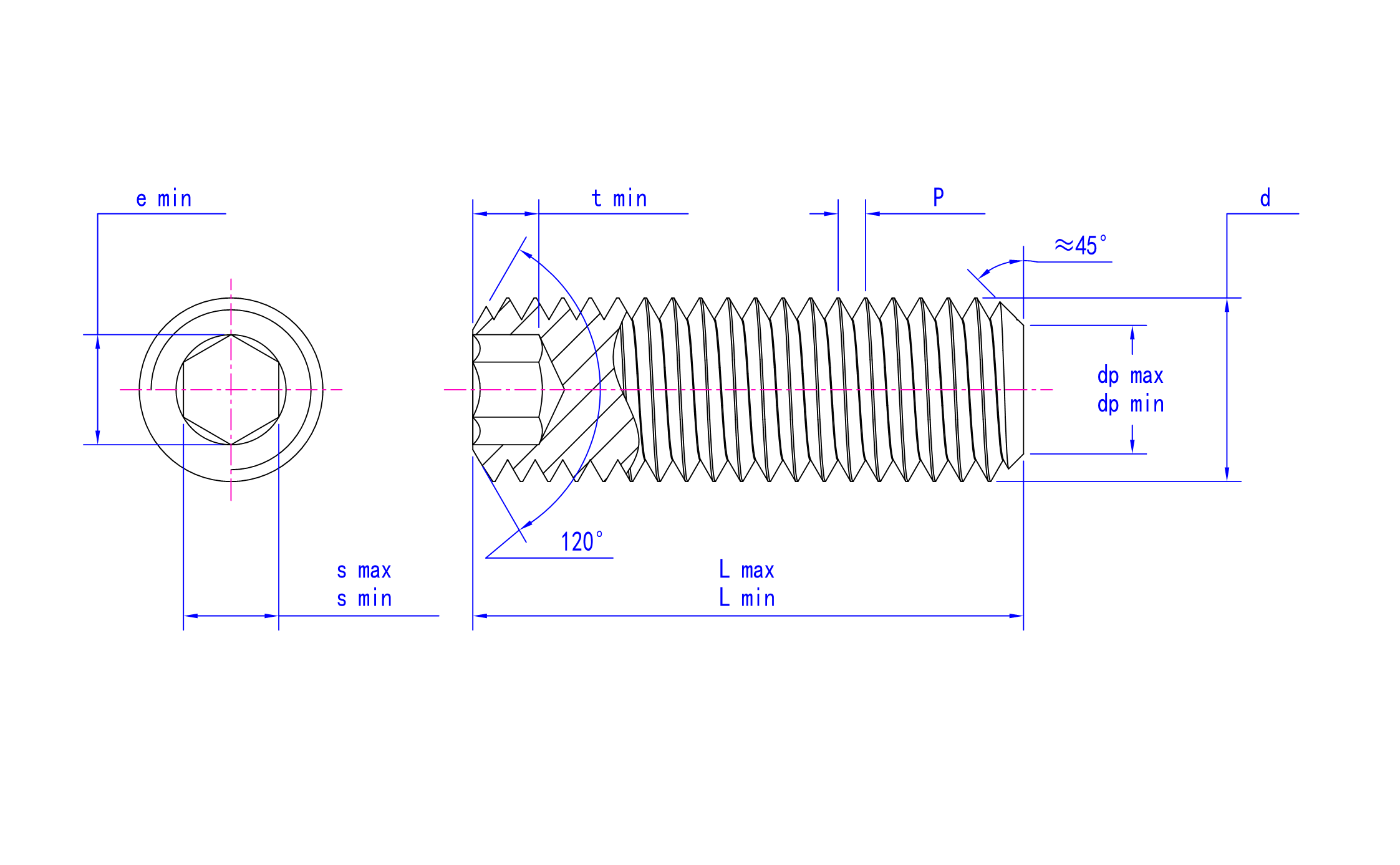
| Parameter | M1.4 | M1.6 | M1.8 | M2 | M2.5 | M3 | M4 | M5 | M6 | M8 | M10 | M12 | M14 | M16 | M18 | M20 | M22 | M24 |
|---|---|---|---|---|---|---|---|---|---|---|---|---|---|---|---|---|---|---|
| P | 0.3 | 0.35 | 0.35 | 0.4 | 0.45 | 0.5 | 0.7 | 0.8 | 1 | 1.25 | 1.5 | 1.75 | 2 | 2 | 2.5 | 2.5 | 2.5 | 3 |
| dp/max | 0.7 | 0.8 | 0.9 | 1 | 1.5 | 2 | 2.5 | 3.5 | 4 | 5.5 | 7 | 8.5 | 10 | 12 | 13 | 15 | 17 | 18 |
| dp/min | 0.45 | 0.55 | 0.65 | 0.75 | 1.25 | 1.75 | 2.25 | 3.2 | 3.7 | 5.2 | 6.64 | 8.14 | 9.64 | 11.57 | 12.57 | 14.57 | 16.57 | 17.57 |
| e/min | 0.803 | 0.803 | 0.803 | 1.003 | 1.427 | 1.73 | 2.3 | 2.87 | 3.44 | 4.58 | 5.72 | 6.86 | 6.86 | 9.15 | 11.43 | 11.43 | 13.72 | 13.72 |
| s/min | 0.711 | 0.711 | 0.711 | 0.889 | 1.27 | 1.52 | 2.02 | 2.52 | 3.02 | 4.02 | 5.02 | 6.02 | 6.02 | 8.025 | 10.025 | 10.025 | 12.032 | 12.032 |
| s/max | 0.724 | 0.724 | 0.724 | 0.902 | 1.295 | 1.545 | 2.045 | 2.56 | 3.08 | 4.095 | 5.095 | 6.095 | 6.095 | 8.115 | 10.115 | 10.115 | 12.142 | 12.142 |
| t/min | 0.6 | 0.7 | 0.8 | 0.8 | 1.2 | 1.2 | 1.5 | 2 | 2 | 3 | 4 | 4.8 | 5.6 | 6.4 | 7.2 | 8 | 9 | 10 |
Engineering references
Selection
The flat point applies broad contact to collars, hubs, gears and pulleys with less intentional penetration than cone- or cup-point set screws. Joint holding capacity still depends on contact force, shaft material and the complete design.
Automotive and EV fastenersHeadless installation suits compact mechanisms where the screw must sit flush or recessed. Verify tapped-hole depth, key engagement and point contact before assembly.
Industrial equipment fastenersAssembly
Manufacturing
FAQ
DIN 913 has a flat point that spreads contact; DIN 916 has a cup point that bites into the mating surface. They serve different contact functions and are not automatic substitutes.
Yes, ISO 4026 is the correct successor family for a flat-point hexagon socket set screw. Confirm the cited edition, dimensions, hardness class and coating before conversion.
No. 45H is common commercially, but the dimensional designation alone does not define every product as 45H. State the required hardness class explicitly.
No. A headless set screw is not intended to act as a conventional tensile-loaded bolt. It applies point contact or radial clamping within a designed assembly.
They can be supplied with an approved zinc process, but high-hardness parts require controls for hydrogen embrittlement, coating build-up and thread or socket fit.
Send the thread size, length, hardness class, coating, quantity and mating-surface requirements. Include the controlled drawing or legacy pitch callout for non-standard applications.
Get engineering support and pricing for this product — our team responds within 24 hours.