Quick answer: DIN 980-V and DIN 980-M replacements
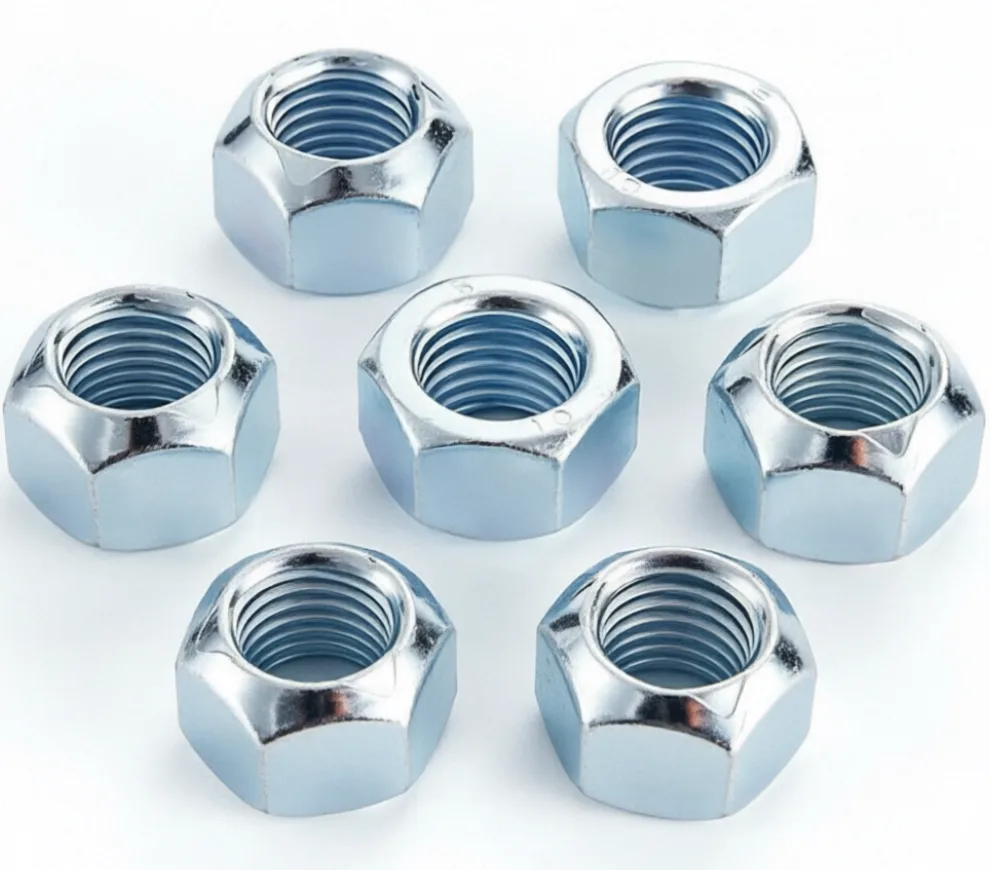
DIN 980 is a withdrawn legacy standard for all-metal prevailing-torque hexagon nuts. The DIN form must be identified before conversion:
- DIN 980-V → ISO 7719: Type/Style 1, regular-height all-metal prevailing-torque nut
- DIN 980-M → ISO 7042: Type/Style 2, high or thick all-metal prevailing-torque nut
DIN 980-M is the form most commonly encountered in commercial DIN 980 stock. That market convention is useful when searching for a supplier, but it is not permission to assume M form on a controlled legacy drawing.
View the DIN 980 drawing and dimensions, or compare the DIN 985 non-metallic-insert family.
Correct DIN 980 cross-reference
| Legacy callout | Principal ISO relationship | Type and height | Procurement status |
|---|---|---|---|
| DIN 980-V | ISO 7719 | Type/Style 1, regular height | Correct primary comparison for the V form |
| DIN 980-M | ISO 7042 | Type/Style 2, high/thick height | Correct primary comparison for the M form and the most common commercial DIN 980 form |
| DIN 980 without V/M | Not enough information | Height series is unknown | Inspect the drawing, old specification or sample before conversion |
The two arrows are product-family relationships, not a claim that every DIN and ISO edition has identical dimensions or performance. Preserve the complete thread, nut class, finish and prevailing-torque requirement.
DIN 980-V vs DIN 980-M: explicit differences
| Feature | DIN 980-V / ISO 7719 | DIN 980-M / ISO 7042 | Procurement impact |
|---|---|---|---|
| Legacy DIN form | V | M | The form letter is a functional part of the old designation |
| ISO product family | ISO 7719 | ISO 7042 | Do not route both forms to ISO 7042 |
| Type/style | Type/Style 1 | Type/Style 2 | They belong to different ISO dimensional families |
| Height series | Regular height | High/thick height | Changes installation envelope and available thread engagement |
| Commercial prevalence | Less commonly encountered | Most common market DIN 980 stock | Supplier default is often M, but a controlled drawing still governs |
Width across flats s |
Verify the ISO 7719 size table against the DIN-V drawing | Verify the ISO 7042 size table against the DIN-M drawing | Affects socket fit, counterbores and tooling |
Width across corners e |
Controlled by the Type 1 table | Controlled by the Type 2 table | Affects radial clearance and minimum corner geometry |
| Metal-body / wrenching height | Regular-height dimensional envelope | Greater high/thick dimensional envelope | Affects tool contact and usable thread length |
| Overall height | Lower family | Higher family | Can create clearance conflicts or change protruding bolt length |
| Locking-zone construction and location | Must match the approved V-form drawing and ISO 7719 product | Must match the approved M-form drawing and ISO 7042 product | Same all-metal principle does not prove identical deformation geometry or orientation |
| Thread series | Preserve diameter and pitch; confirm the applicable coarse/fine branch | ISO 7042 current basic route is coarse pitch; a fine-pitch high nut requires the applicable fine-thread branch | Never remove a pitch such as M20 × 1.5 during conversion |
| Nut class and proof load | Specify the class allowed by the selected Type 1 standard | Specify the class allowed by the selected Type 2 standard | Similar appearance does not prove equal load capacity |
| Initial prevailing torque | Test to the governing specification and mating fastener | Test to the governing specification and mating fastener | Dimensional fit alone does not confirm locking performance |
| Reuse prevailing torque | Must remain above the stated minimum after permitted cycles | Must remain above the stated minimum after permitted cycles | Do not approve reuse from appearance alone |
| Material, coating and lubrication | Must be controlled with the mating thread | Must be controlled with the mating thread | Changes friction, galling risk, preload and prevailing torque |
The most important dimensional difference is the height family: V routes to regular Type 1, while M routes to high/thick Type 2. Exact values for s, e, wrenching height and overall height must come from the controlled size tables for the nominal diameter and edition; do not insert one catalogue value into every DIN/ISO conversion.
Why the standards can be cross-referenced
DIN 980-V, DIN 980-M, ISO 7719 and ISO 7042 all describe all-metal prevailing-torque hexagon nuts. They create rotational resistance through a controlled metal locking zone rather than a nylon/polyamide insert. This shared product function and the DIN-to-ISO succession path make the comparisons useful to buyers.
They are not one interchangeable shape because Type 1 and Type 2 use different height families. In addition, editions may differ in widths, height limits, bearing geometry, tolerances, nut classes, proof load, prevailing-torque requirements, test references and marking.
Coarse and fine pitch must stay separate
The basic ISO 7719 and ISO 7042 routes describe their applicable all-metal families; ISO 7042:2025 is the current coarse-pitch high-nut branch. A fine-pitch legacy callout cannot be converted by retaining only the nominal diameter.
For example, preserve M20 × 1.5, not merely M20. For a high M-form fine-thread requirement, review the applicable ISO 10513 fine-pitch family and edition. For any V-form fine-thread callout, identify the applicable Type 1 fine-thread product standard from the controlled specification instead of silently substituting coarse-pitch ISO 7719.
All-metal locking is not DIN 985 nylon locking
| Feature | DIN 980-V / DIN 980-M | DIN 985 / ISO 10511 |
|---|---|---|
| Locking principle | All-metal prevailing-torque feature | Non-metallic insert interference |
| Polymer insert | No | Yes |
| Temperature limitation | Determined by metal, heat treatment, coating, lubricant and joint | Also limited by insert material |
| Replacement relationship | Choose V/Type 1 or M/Type 2 | Different low nylon-insert product family |
All-metal construction removes the polymer insert, but it does not create a universal temperature rating. The actual material system, coating, lubrication, bolt and service environment still govern acceptance.
ASME, UNI and JIS relationship classification
The primary DIN/ISO cross-reference remains ISO 7719 for V and ISO 7042 for M. For regional procurement searches, add UNI 7474 and JIS B 1187-2 as related counterparts and identify their exact relationship before substitution.
| Regional reference | Why it appears in supplier searches | Actual relationship to DIN 980 |
|---|---|---|
| ASME B18.16.6 | Covers related inch-series prevailing-torque locknut products | Approximate functional reference only; thread system, dimensions, style and performance differ |
| UNI 7474 | Italian self-locking-nut counterpart used in European procurement tables | Valid regional cross-reference; confirm whether the offered form matches DIN 980-V or M, then compare height, s, e, thread, nut class and prevailing torque |
| JIS B 1187-2 | Japanese reference for the related all-metal prevailing-torque nut family | Valid functional cross-reference; confirm JIS type/edition, height series, dimensional table, proof load, torque test and marking before substitution |
These regional codes are useful, mainstream purchasing counterparts. They explain why the parts are cross-referenced, but they do not remove the DIN V/M distinction or prove one-to-one dimensions for every size and edition.
Installation, prevailing torque and reuse
The locking feature must fully engage the mating bolt thread in the intended direction. Some all-metal designs have a localized locking zone or installation orientation, so follow the exact standard drawing and manufacturer instructions instead of applying one universal orientation rule.
Confirm both initial and reuse prevailing torque using the governing performance requirement and controlled mating fastener. Coating wear, thread damage and repeated cycles can change torque. Reuse is allowed only when the specification permits it and the measured torque remains within limits.
Stainless or poorly lubricated all-metal thread pairs can gall. Material, hardness, surface treatment and approved lubrication must be selected together. Uncontrolled lubrication is not a harmless fix because it also changes the torque–tension relationship and prevailing torque.
DIN 980 RFQ and conversion checklist
Include:
- DIN 980 form: V or M
- Conversion target: ISO 7719 Type 1 for V or ISO 7042 Type 2 for M
- Exact standard edition
- Complete diameter, pitch and thread tolerance
- Regular-height or high/thick height requirement
- Width across flats
s, cornerse, wrenching height and overall height when drawing-critical - Nut property class, proof load, material and heat treatment
- Initial and reuse prevailing-torque limits and test method
- Mating-bolt class, coating, thread condition and installation orientation
- Finish, lubrication, corrosion, temperature, inspection and traceability requirements
Examples:
Legacy DIN 980-V, M12 coarse pitch, convert only to an approved ISO 7719 Type 1 regular-height part after dimensional and prevailing-torque comparison.
Legacy DIN 980-M, M12 coarse pitch, ISO 7042 Type 2 high/thick candidate, Class 10, zinc flake; confirm controlled dimensions, coating, initial/reuse prevailing torque and lot traceability.
A bare DIN 980 M12 order is incomplete if the V/M form is unknown. Commercial stock will often return the M form, but the buyer should not turn that default into an undocumented engineering change.
Related resources
- DIN / ISO / ASME / JIS cross-reference chart
- DIN 980 drawing and dimensions
- DIN 985 vs ISO 10511 nylon-insert nuts
- DIN 982 vs ISO 7040 / ISO 10512 insert lock nuts
- All-metal prevailing-torque nut products
Use the cross-reference to identify the correct family. Final acceptance requires the DIN form, exact pitch, dimensional table, nut class, proof load and measured prevailing-torque performance.