Quick answer: are these flat-washer standards interchangeable?
Not automatically. ISO 7089 and DIN EN ISO 7089 express the same adopted ISO dimensional standard. GB/T 97.1 belongs to the corresponding Chinese Grade A plain-washer family. Legacy DIN 125A is the closely related unchamfered predecessor. UNI 6592 and JIS B 1256 require an edition and dimensional check. ASME B18.22.1 uses American inch-series dimensions and is not a direct metric equivalent.
Before substitution, compare the bore, outside diameter, thickness, tolerances, washer form, material, hardness class, coating and the requirements of the complete bolted joint.
| Standard | Main system | Product covered here | Relationship to ISO 7089 | Replacement decision |
|---|---|---|---|---|
| ISO 7089 | ISO metric | Plain washers, normal series, product grade A, without chamfer | Reference standard | Use when the drawing specifies ISO 7089 |
| DIN EN ISO 7089 | German/European adoption | ISO 7089 plain washers | Adoption of ISO 7089 | Normally the same requirement when the edition matches |
| GB/T 97.1 | Chinese metric | Plain washers, Grade A | Corresponding ISO-aligned family | Usually close; confirm edition, hardness and material |
| DIN 125A | Legacy German metric | Plain washers, form A, without chamfer | Predecessor/corresponding standard | Check edition and mechanical requirements before replacement |
| UNI 6592 | Legacy Italian metric | Plain washers | Comparable national reference | Do not confuse it with UNI EN ISO 7089 |
| JIS B 1256 | Japanese metric | Plain washers with JIS classifications | Broader national standard | Confirm exact type, dimensions and edition |
| ASME B18.22.1 | American inch | Plain washers in inch dimensional series | Different dimensional system | Do not substitute by nominal bolt size alone |
What a flat washer actually does
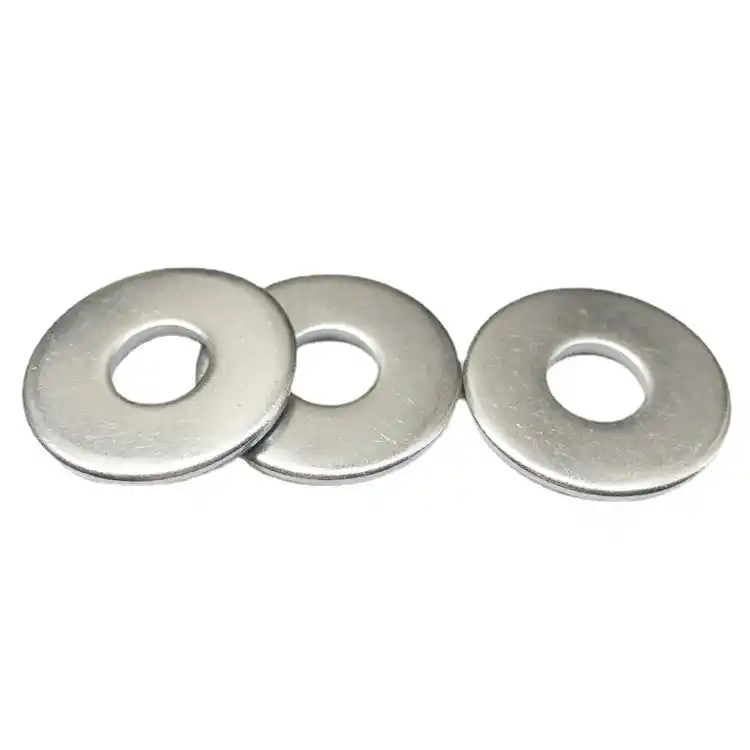
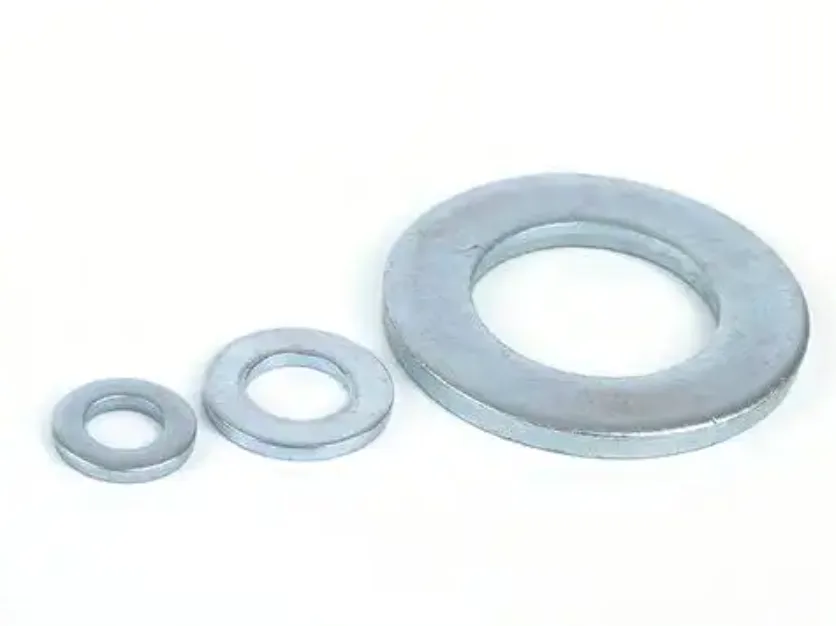
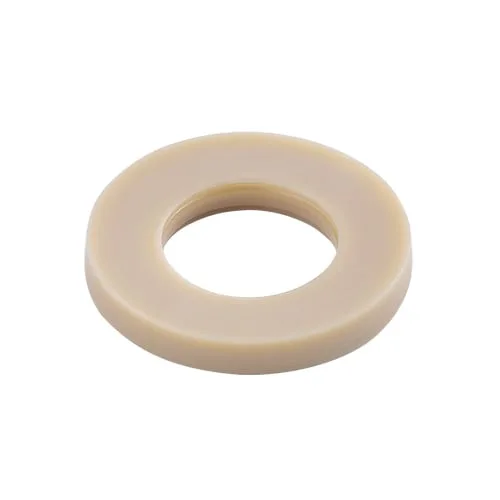
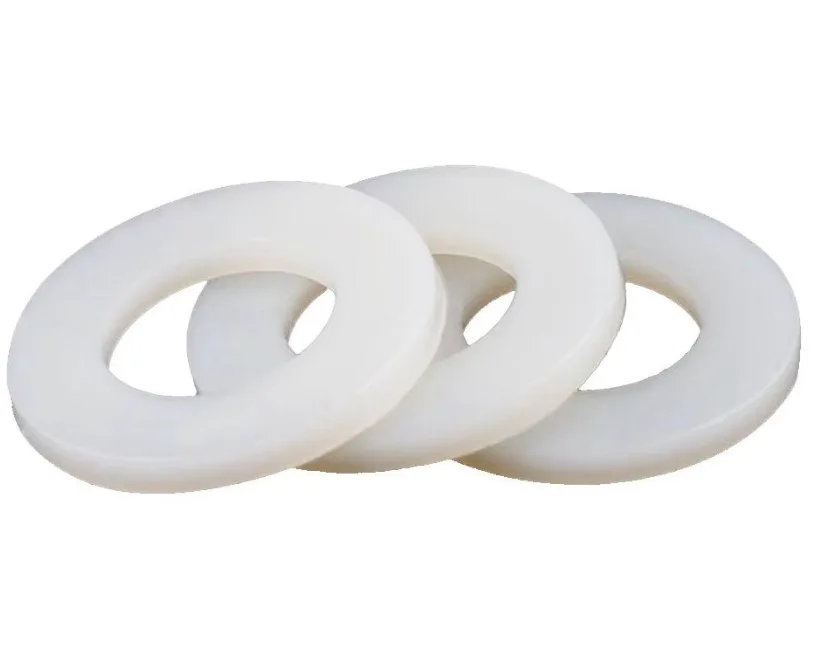
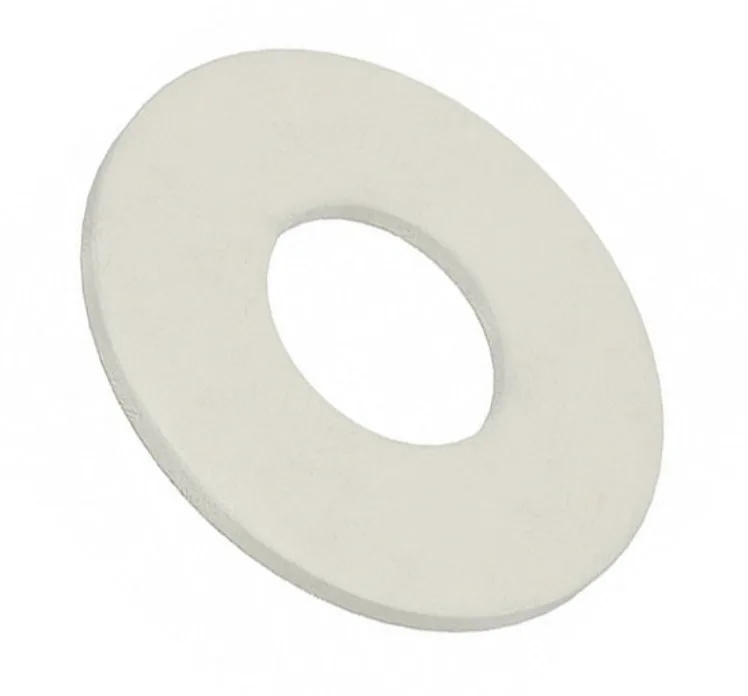
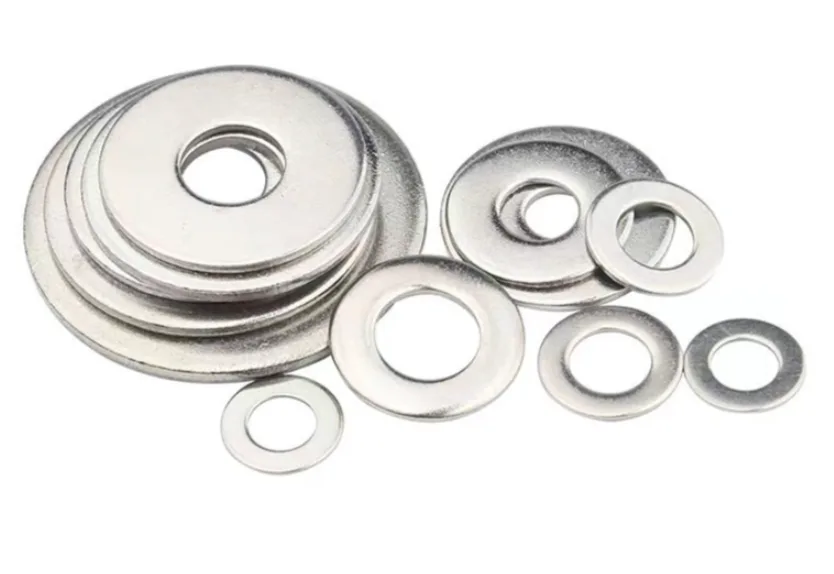
A flat or plain washer sits below a bolt head or nut to increase the bearing area, protect the joint surface and provide a controlled interface during tightening. It can also bridge clearance around a bolt hole and reduce localized indentation in a softer connected part.
A plain washer does not provide spring action or reliable anti-loosening performance by itself. If the joint requires vibration resistance or controlled preload retention, the locking method and complete joint design must be specified separately.
The washer is also part of the load path. An undersized, excessively soft or badly supported washer may dish, embed into the surface or lose effective bearing area, contributing to preload loss even when the bolt and nut are correct.
Return to the complete fastener standard cross-reference when comparing another washer, bolt, nut or screw family.
DIN 125A vs ISO 7089
DIN 125A is the familiar legacy German designation for form-A plain washers without chamfer. ISO 7089 is the current international normal-series reference for unchamfered product-grade-A plain washers, and DIN EN ISO 7089 is its German/European adoption.
For many common metric sizes, the legacy DIN and ISO geometries are closely corresponding. That does not make every washer carrying either label contractually identical. The drawing edition, dimensional tolerances, edge condition, material and hardness requirements still need to be confirmed.
The form letter also matters:
| Legacy form | Edge form | Common ISO comparison |
|---|---|---|
| DIN 125A | Without chamfer | ISO 7089 |
| DIN 125B | With chamfer | ISO 7090 |
Do not replace DIN 125A with a chamfered washer merely because both are called plain washers. The chamfer changes the bearing geometry and can matter next to a head-to-shank radius or in a tightly controlled stack.
ISO 7089 reference dimensions: useful but not a universal substitution table
The following common ISO 7089 nominal values illustrate the normal metric series. Acceptance dimensions and tolerances must come from the controlled standard edition.
| Nominal bolt size | Typical ISO 7089 bore d1 | Outside diameter d2 | Nominal thickness h |
|---|---|---|---|
| M6 | 6.4 mm | 12 mm | 1.6 mm |
| M8 | 8.4 mm | 16 mm | 1.6 mm |
| M10 | 10.5 mm | 20 mm | 2.0 mm |
| M12 | 13.0 mm | 24 mm | 2.5 mm |
| M16 | 17.0 mm | 30 mm | 3.0 mm |
These dimensions should be compared with the actual DIN, GB/T, UNI, JIS or ASME table cited on the drawing. A small increase in outside diameter may prevent a washer from seating in a counterbore. A thinner washer may deform more under a concentrated bearing load. A larger bore may reduce the effective support around an oversized clearance hole.
ISO 7089 and DIN EN ISO 7089
DIN EN ISO 7089 is the German/European publication of ISO 7089. When the cited editions match, they normally contain the same ISO dimensional requirements.
However, the dimensional designation alone is not a complete purchase specification. The order must still state the material, hardness or mechanical-property requirement, coating, surface condition and inspection documentation. A stainless ISO 7089 washer and a 300 HV carbon-steel ISO 7089 washer may have matching dimensions but are not performance substitutes.
Where GB/T 97.1 fits
GB/T 97.1 is the Chinese Grade A plain-washer standard corresponding to the ISO 7089 family. Published editions have been aligned with the ISO normal-series product, which makes GB/T 97.1 a practical sourcing reference for metric washers made in China.
For a controlled order, state the exact GB/T edition and verify the dimensional table, tolerance grade, material, hardness and coating. The appropriate conclusion is “corresponding and commonly dimensionally compatible after verification,” rather than assuming every historical DIN, ISO and GB/T edition is automatically identical.
Why ASME B18.22.1 must be assessed separately
ASME B18.22.1 defines American inch-series plain washers. The exact bore, outside diameter and thickness depend on the nominal inch fastener size and the washer type or series specified by the applicable edition.
Unlike a nut, a washer does not engage the bolt thread. An inch washer may therefore physically pass over some metric bolts. Physical assembly alone does not prove equivalence. A candidate washer can still have excessive bore clearance, insufficient or excessive outside diameter, the wrong thickness, a different bearing area or unsuitable hardness.
The nominal value 3/8 inch equals 9.525 mm, but that is the nominal fastener diameter—not the finished washer bore. The actual washer opening must include clearance and varies with the ASME type or series. It is therefore incorrect to convert 3/8 inch directly into a 9.52 mm washer inside diameter.
For American equipment, retain ASME B18.22.1 unless a documented comparison approves a metric alternative. For a US metric washer requirement, identify the applicable metric washer standard rather than approximating an inch size.
UNI 6592 and UNI EN ISO 7089 are different designations
UNI 6592 is a legacy Italian national reference found on older Italian machinery drawings, parts lists and maintenance documentation.
Italy's adoption of the current ISO document is identified as UNI EN ISO 7089. It should not be shortened to UNI 6592 and then described as automatically identical. For a legacy conversion, verify the original UNI edition and drawing dimensions, then record the customer-approved replacement explicitly.
Why JIS B 1256 needs the exact washer class
JIS B 1256 covers plain washers using Japanese classifications and dimensional choices. A JIS drawing may depend on the washer type or class, bore tolerance, outside diameter, thickness and edition.
Do not publish or approve a JIS-to-ISO substitution from one unqualified M6, M8 or M10 row. Values can be quoted from different JIS classes or historical editions and then incorrectly presented as one universal JIS B 1256 washer. Request the original drawing or controlled JIS table and compare d1, d2, h, tolerances and edge form.
This is especially important for Japanese automotive and machinery assemblies where the washer sits in a formed pocket, counterbore, slotted bracket or tightly controlled stack height.
Hardness is a joint requirement, not a marketing detail
Modern normal-series washers may be specified with hardness classes such as 200 HV or 300 HV, subject to the governing product and mechanical-property requirements. A legacy DIN 125A washer should not be universally described as “140 HV”; actual supply depends on the cited document, material and purchase specification.
Washer hardness must be compatible with the mating bolt property class, bearing stress and connected material. If the washer is too soft, it may dish or embed, reducing preload. If the washer is unnecessarily hard against a brittle or coated surface, the interface may also require review.
A general ISO 7089 washer is not automatically the correct washer for every structural or preloaded joint. Structural assemblies may require dedicated products such as ASTM F436 hardened washers or EN 14399 structural washers, together with the applicable assembly standard.
Interchangeability decision matrix
| Proposed replacement | General assessment | Required action |
|---|---|---|
| ISO 7089 ↔ DIN EN ISO 7089 | Normally the same adopted ISO requirement | Confirm edition, material and hardness designation |
| DIN 125A → ISO 7089 | Common legacy-to-current conversion | Check dimensions, tolerances, edge form and hardness |
| ISO 7089 ↔ GB/T 97.1 | Commonly corresponding Grade A metric washer family | Compare cited editions and technical requirements |
| UNI 6592 → ISO 7089 | Possible legacy conversion | Verify original UNI dimensions and obtain approval |
| JIS B 1256 → ISO 7089 | Depends on exact JIS type or class | Compare the controlled dimensional tables |
| ASME B18.22.1 → ISO 7089 | Different inch and metric dimensional systems | Check bore, OD, thickness, series, hardness and joint geometry |
Practical replacement workflow
- Read the full callout. Record the standard, form or class, edition, nominal bolt size and any hardness marking.
- Identify the dimensional system. Separate metric ISO/DIN/GB/UNI/JIS callouts from American inch series.
- Compare d1, d2 and h. Include tolerances, not just nominal values.
- Check the available envelope. Confirm counterbore diameter, pocket depth, slot width and total joint stack height.
- Review the bearing interface. Check the bolt-head or nut bearing diameter, hole clearance and connected-part material.
- Specify performance. State material, hardness class, coating and corrosion requirements.
- Confirm the application. General assembly, structural preload, dynamic machinery and soft-material joints may require different washers.
- Document approval. Attach the dimensional comparison when converting a legacy or regional standard.
Common procurement failures
Ordering only “M10 flat washer”
The supplier may choose a local standard, outside-diameter series or hardness that does not match the drawing. State the full standard and performance designation.
Using nominal bolt size as the washer bore
A washer needs clearance over the fastener. The finished bore is larger than the nominal bolt diameter and varies by standard, series and tolerance.
Ignoring the counterbore or slot
A washer can fit over the bolt and still fail the assembly because its outside diameter is too large for the pocket or too small to bridge the slot.
Treating all flat washers as low-risk commodity parts
Washer deformation and embedment can reduce joint preload. High-strength, structural, coated or soft-material joints require a deliberate hardness and bearing-area selection.
Mixing coating systems without checking fit
Hot-dip galvanized coatings affect dimensions and the friction/bearing interface. Confirm that the washer, bolt and nut are specified as a compatible assembly.
What to include on the RFQ or purchase order
- Standard, form/class and edition;
- Nominal bolt size and required bore, OD and thickness where drawing-controlled;
- Material and hardness class;
- Surface treatment and coating specification;
- Application and mating bolt property class;
- Counterbore, slot or bearing-area constraints;
- Quantity, inspection report, certificate and traceability requirements.
Browse general flat washers, carbon-steel flat washers and application-specific hardened structural washers. For a legacy, JIS or special-dimension washer, send the original drawing through the contact page for review.
Final recommendation
Use ISO 7089 or its current national adoption for new normal-series metric washer specifications when appropriate. Treat DIN 125A as a closely corresponding legacy reference, and verify the mechanical requirements as well as the dimensions. Keep UNI 6592, JIS B 1256 and ASME B18.22.1 tied to their exact drawing, type and edition until a documented comparison is approved. A safe washer substitution is defined by fit, bearing area, thickness, hardness and joint performance—not by a cross-reference row alone.