What Is DIN 127B?
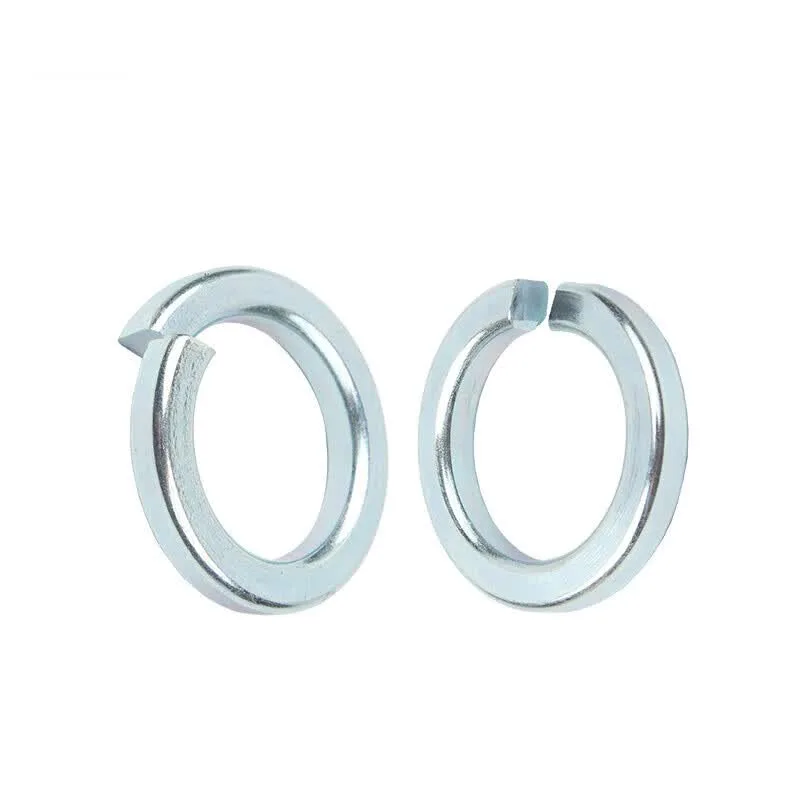
DIN 127B is a legacy German standard for split helical spring lock washers, commonly called spring washers, split lock washers or helical lock washers. The washer is formed as an open helical ring and is compressed beneath a nut or screw head during tightening.
DIN 127B remains widely referenced on drawings and purchase orders. There is no simple, widely adopted ISO successor that should be inserted as a direct equivalent.
Browse spring washers for related product options.
DIN 127B Cross-Reference at a Glance
| System | Reference | Relationship to DIN 127B |
|---|---|---|
| DIN | DIN 127B | Legacy German split spring washer reference |
| China | GB/T 93 | Closely related Chinese standard spring washer |
| United States | ASME B18.21.1 | Broader lock-washer standard; exact helical washer series and dimensions required |
| Italy | UNI 1751 | Legacy Italian spring-washer reference |
| Japan | JIS B 1251 | Japanese spring-washer standard; exact type and dimensional series required |
| ISO | — | No direct ISO equivalent listed |
These references identify related product families. They do not prove one-to-one dimensional interchangeability.
DIN 127 Form A vs Form B
DIN 127 includes different forms. A drawing that specifies Form B should not be supplied as Form A without comparing the applicable edition and geometry. Do not classify Form B simply as a “heavy” version; the form designation concerns the washer design, and the requested suffix must be retained in the RFQ.
If a drawing states only “DIN 127,” ask the customer to confirm the form rather than assuming it.
DIN 127B vs GB/T 93
GB/T 93 is the most common Chinese cross-reference encountered for a standard metric spring washer. It is useful for sourcing, but substitution should still compare:
- Nominal size and inside diameter
- Outside diameter
- Section width and thickness
- Free height and helical geometry
- Material, hardness and heat treatment
- Surface treatment
Specify DIN 127B when the drawing controls DIN geometry. Use GB/T 93 when that standard is contractually accepted; do not replace the standard number on a controlled drawing without approval.
DIN 127B vs ASME B18.21.1
ASME B18.21.1 covers lock washers and includes helical spring lock-washer series. It is broader than a single DIN 127B product, and American series may include different duties or dimensional choices.
Therefore, “ASME B18.21.1” alone is not enough for substitution. Confirm the exact washer type, metric or inch thread system, regular or other specified series, inside diameter, section and material.
DIN 127B vs UNI 1751 and JIS B 1251
UNI 1751 is a legacy Italian spring-washer reference commonly found on older European documentation. JIS B 1251 covers Japanese spring washers and may contain more than one type or dimensional series.
Use both as cross-reference leads, not automatic replacements. Confirm the original standard edition and dimensional table before ordering.
Dimensions to Check
| Dimension | Why it matters |
|---|---|
| Inside diameter | Clearance over the bolt thread or shank |
| Outside diameter | Bearing envelope and surrounding clearance |
| Section width | Contact area and washer geometry |
| Thickness | Stack height and elastic behavior |
| Free height | Uncompressed helical form |
| End and split geometry | Identifies the required washer form |
A description such as “M10 spring washer” is incomplete. State the standard, form, material and finish.
Does a Spring Washer Prevent Vibration Loosening?
A split spring washer should not be presented as a universal solution for severe transverse vibration. In a highly preloaded joint, it can be compressed nearly flat, leaving limited elastic travel. Its actual resistance to self-loosening depends on the complete joint, preload, bearing surfaces and loading direction.
For a vibration-critical assembly, evaluate a locking method with performance appropriate to the application, such as:
- Nylon insert prevailing-torque nuts
- All-metal prevailing-torque nuts
- Wedge-locking washer systems
- Qualified thread-locking compounds
- Positive locking specified by the design authority
Do not change the locking method without engineering approval.
Materials and Finishes
Spring steel and stainless steel are common supply materials, but the dimensional standard alone does not establish every material, hardness or spring-performance requirement. Do not assume one steel grade, such as 65Mn, applies to every DIN 127B order.
Common finishes include plain, black oxide, zinc plated, zinc flake, phosphate and passivated stainless surfaces. State material, hardness or governing material requirement, coating and corrosion performance separately.
Stainless and carbon spring steel do not necessarily provide identical elastic behavior at the same nominal dimensions. Confirm the application requirement when changing material.
DIN 127B vs Flat and Conical Washers
| Reference | Product | Main function or geometry |
|---|---|---|
| DIN 127B | Split helical spring washer | Helical spring form |
| DIN 125A / ISO 7089 | Flat washer | Bearing-load distribution and surface protection |
| DIN 6796 | Conical spring washer | Conical geometry with different load-deflection behavior |
These products are not interchangeable merely because all are installed under a nut or screw head.
RFQ Checklist
Include:
- DIN 127B and applicable edition
- Nominal bolt size
- Inside and outside diameters if drawing-controlled
- Section width, thickness and free height if critical
- Material and hardness requirement
- Surface treatment
- Quantity and packaging
- Inspection and certificate requirements
- Vibration or locking performance requirement, if any
Example:
DIN 127B spring lock washer, M10, hardened spring steel, zinc plated, dimensions and hardness to the specified edition, inspection certificate required.
Related Resources
- DIN / ISO / ASME / JIS cross-reference chart
- DIN 125A vs ISO 7089 flat washers
- DIN 6796 conical spring washers
- DIN 985 nylon insert lock nuts
- Spring washers
Use this cross-reference for sourcing guidance. The drawing, standard edition and engineering approval govern a controlled substitution.