
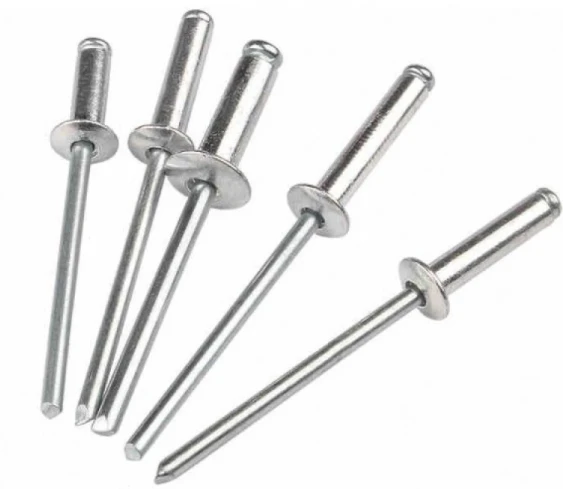
Open-End Blind Rivets
| Standard | DIN 7337 · ISO 15977 |
|---|---|
| Material | Aluminum Alloy Body / Zinc-Plated Carbon Steel Mandrel |
| Strength Grade | AlA/St (Aluminum / Steel) |
| Size Range | 2.4-6.4 mm |
| Surface Treatment | Natural Aluminum Body / Zinc-Plated Mandrel |
| Standard | DIN 7337 · ISO 15977 |
|---|---|
| Material | Aluminum Alloy Body / Zinc-Plated Carbon Steel Mandrel |
| Strength Grade | AlA/St (Aluminum / Steel) |
| Size Range | 2.4-6.4 mm |
| Surface Treatment | Natural Aluminum Body / Zinc-Plated Mandrel |
Product Description
Open-end dome-head blind rivets are the most widely used general-purpose blind rivet type. Installation is completed entirely from one side, making them suitable for sheet, tube, panel and enclosure assemblies where the rear face cannot be reached.
During installation, the rivet tool pulls the steel mandrel through the aluminum body. The body expands and forms a blind-side bulb; once the intended setting load is reached, the mandrel breaks at its designed break point and leaves a permanent joint without a separate nut.
Correct selection depends on rivet diameter, body length, grip range, hole diameter, head style, material combination and required shear or tensile load. Diameters 3.2, 4.0, 4.8 and 6.4 mm are common for sheet-metal panels, automotive trim, railway interiors, HVAC ducting, enclosures and light fabrication.
| Product type | Open-end blind rivets / pull rivets / POP rivets |
|---|---|
| Standards | DIN 7337 / ISO 15977 |
| Material combination | Aluminum alloy body / zinc-plated carbon steel mandrel (AlA/St) |
| Head style | Dome or protruding head; large flange and countersunk options by drawing |
| Diameter range | 2.4-6.4 mm |
| Common diameters | 3.2 mm, 4.0 mm, 4.8 mm and 6.4 mm |
| Selection basis | Body length and grip range selected by total thickness of the joined materials |
| Surface finish | Natural aluminum body / zinc-plated steel mandrel |
| Installation | One-side setting with a manual, pneumatic or cordless rivet tool |
| Documentation | CoC, material certificate, dimensional report and shear or tensile test report on request |
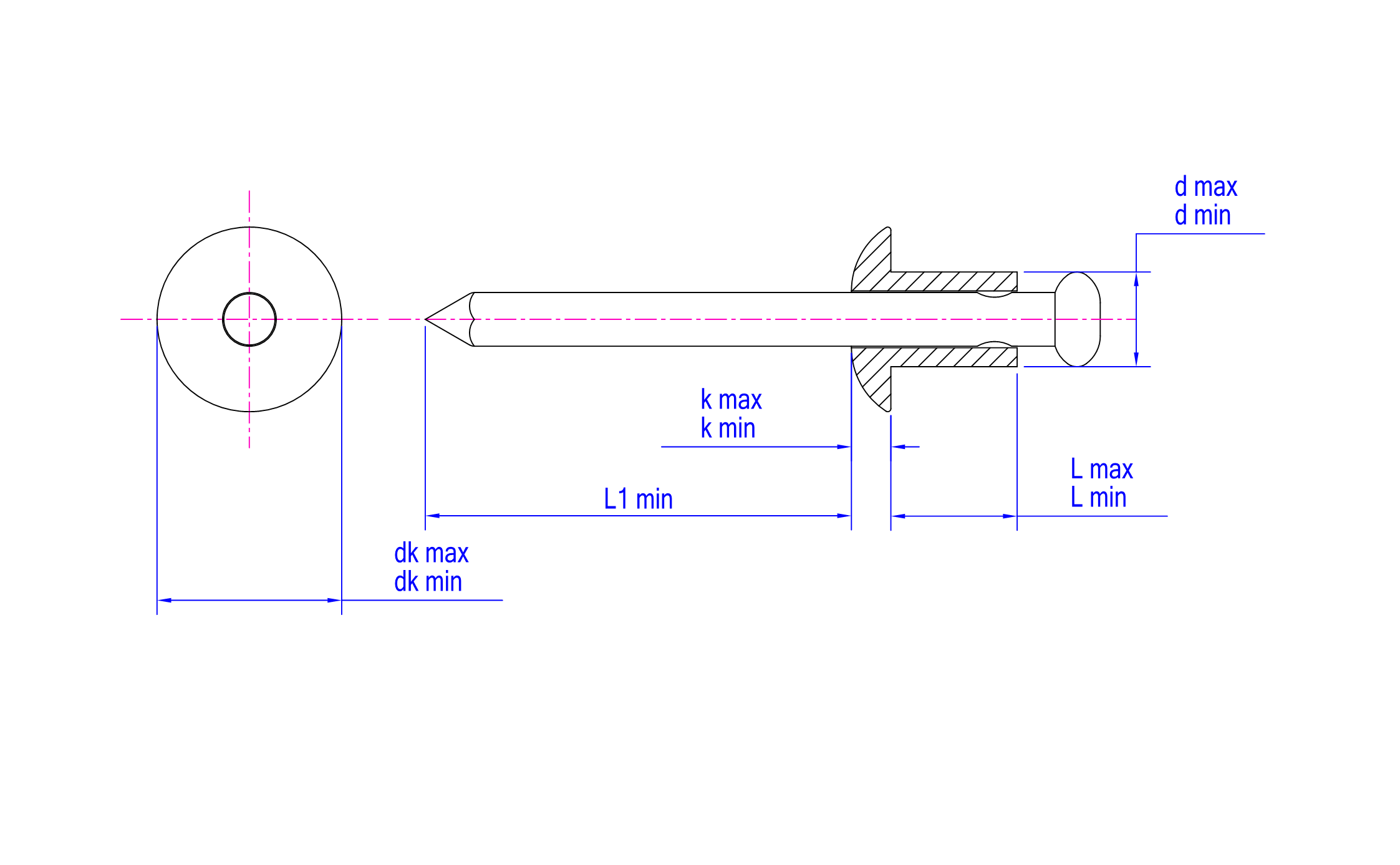
| Parameter | Φ2.4 | Φ3 | Φ3.2 | Φ4 | Φ4.8 | Φ5 | Φ6 | Φ6.4 |
|---|---|---|---|---|---|---|---|---|
| d/max | 2.48 | 3.08 | 3.28 | 4.08 | 4.88 | 5.08 | 6.08 | 6.48 |
| d/min | 2.3 | 2.9 | 3.1 | 3.85 | 4.65 | 4.85 | 5.85 | 6.25 |
| dk/max | 5 | 6.5 | 6.5 | 8 | 9.5 | 9.5 | 12 | 13 |
| dk/min | 4.3 | 5.8 | 5.8 | 7 | 8.5 | 8.5 | 10.5 | 11.5 |
| k/max | 0.7 | 1 | 1 | 1.3 | 1.4 | 1.4 | 1.9 | 2.2 |
| k/min | 0.4 | 0.6 | 0.6 | 0.7 | 0.8 | 0.8 | 1.1 | 1.4 |
| L1/min | 27 | 27 | 27 | 27 | 27 | 27 | 27 | 27 |
Engineering references
Selection
Al/St blind rivets are used for covers, brackets, trim and light channels where assembly-line speed and one-side access are important.
Automotive and EV fastenersBlind rivets allow one-side installation of interior panels, air ducts and service covers. Vibration, grip range and joint load should be confirmed for critical projects.
Railway fastenersDiameters 4.0-6.4 mm are common in enclosures, guards, signs and fabricated brackets that need fast permanent fastening without welding or a rear nut.
Construction and infrastructure fastenersAssembly
Manufacturing
FAQ
It is a permanent two-piece fastener installed from one side. The tool pulls the mandrel to expand the rivet body behind the sheet, then the mandrel breaks when setting is complete.
Add the thickness of every layer being joined, then select a rivet length whose published grip range includes that total thickness.
Diameters 3.2, 4.0 and 4.8 mm are widely used for general sheet metal; 6.4 mm is used when the design requires a larger joint.
Yes. That is the primary advantage of blind riveting: the complete setting operation is performed from the front side with a suitable rivet tool.
Send diameter, length or grip range, panel thickness, hole diameter, head style, material combination, required shear or tensile load and quantity.
Send diameter, length or grip range, total thickness, hole diameter, head style, material combination and quantity. We can quote Al/St blind rivets from 2.4 to 6.4 mm to DIN 7337 / ISO 15977.
Get engineering support and pricing for this product — our team responds within 24 hours.